 by Richard Avery
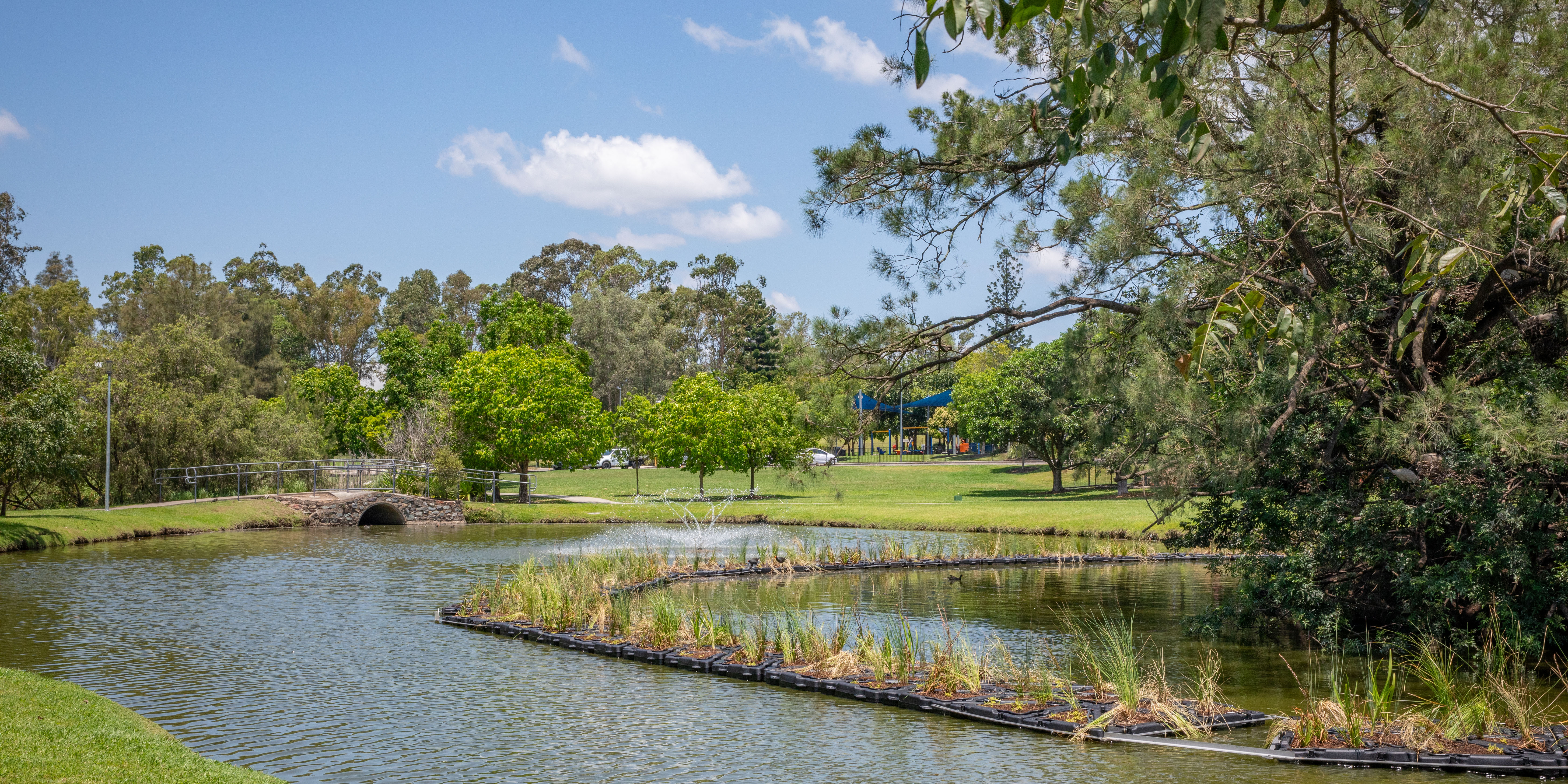
In 2022, Gympie in South East Queensland was hit with its worst flooding event in more than a century. More than 400 millimetres of rain fell in 24 hours, the river peaked at 22.96 metres and over 1,000 properties were submerged.
Lake Alford Park, the “duck ponds” to locals, was left with collapsing banks and degraded water quality. A much‑loved community asset was severely affected.
Walking through Lake Alford Park, it hit me that this wasn’t just an event that happened in the past. The impact to water quality, wildlife and nature would continue to worsen with every rainfall unless we thought differently and holistically about the lake’s restoration.
Challenging the status quo of flood restoration
This story will feel familiar to many councils. After a major flood, the pressure is to clean up, make things safe and get back to normal as fast as possible. But what if we challenge the status quo? Can a damaged park become more than repaired infrastructure, but instead work as flood infrastructure that improves water quality and biodiversity, while strengthening community life at the same time?
At Lake Alford, we helped Gympie Regional Council choose the longer-term solution. By combining smart engineering with living floating wetlands and careful landscape design, the park is now a functioning piece of water‑sensitive infrastructure and a flourishing public place – a model others can adapt.
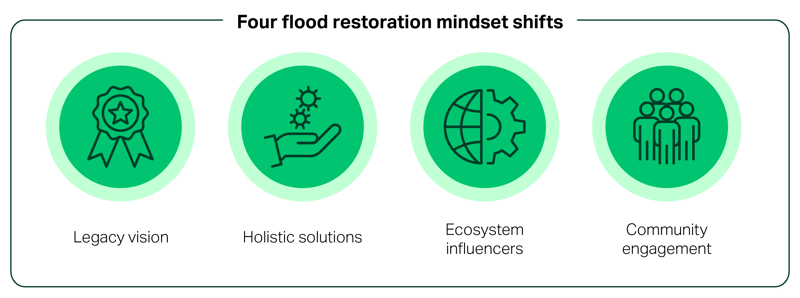
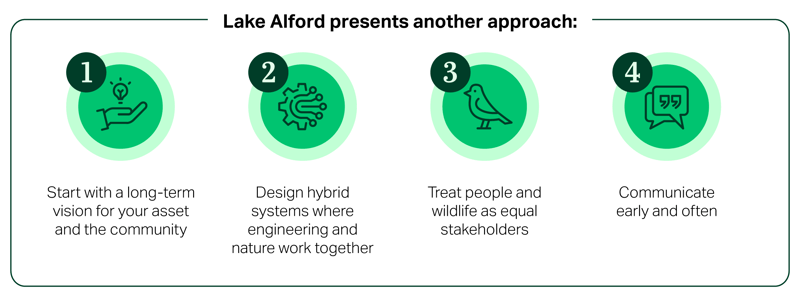
The project offers four key principles – mindset shifts – for any council facing flood-damaged community assets.
1. From reactive restoration to long-term community legacy
When community infrastructure has collapsed after disaster, it’s tempting to come in and treat what you see – eroded banks, damaged planting, broken infrastructure – as the whole problem.
At Lake Alford Park, the visible erosion and collapsing edges were only part of a compounding set of issues: a failed recirculation system, excessive excrement runoff from large bird populations impacting water quality, and sediment running into and polluting downstream waterways.
Rather than engineering solutions for each problem in isolation, we worked with Council to take a step back before any work began and asked: “What is your vision for Lake Alford Park in 10 or 20 years?” That conversation led us to produce a staged masterplan – one that addressed immediate safety and water quality risks, while also setting up future phases that would allow Council to achieve their ultimate vision for the community.
Our lesson for other councils is clear: use disaster recovery funding wisely to install or plan for pieces of your long-term vision where you can, not just to restore assets to pre-flood condition.
2. From hard engineering to hybrid, holistic solutions
The compounding challenges at Lake Alford Park meant there was no silver bullet solution.
Traditional flood responses can default to single-mode problem solving: hard edges to address erosion, pipes for drainage, maybe a gross pollutant trap. At Lake Alford, we exercised the strength of our multidisciplinary team of engineers, ecologists, program managers and landscape architects: deliberately combining engineered and nature-based systems that would reinforce each other and work within Lake Alford’s ecosystem.
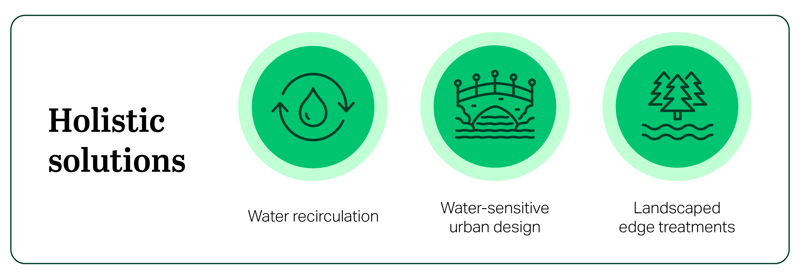
Water recirculation
To address the failed water circulation, we installed a new system to break up water stagnation, breathe oxygen back into the lake for wildlife, and reduce nutrient buildup. But when we designed its alignment, we brought Council’s vision back to our minds. Its location was chosen not just to replace failed assets, but to support future treatment and a bioretention basin that could also be used for educational school demonstrations, turning hydraulic infrastructure into part of a broader ecological story.
Water-sensitive urban design: Floating wetlands
Floating wetlands were the centrepiece of the nature-based response. Excrement runoff from large bird populations was driving algal blooms, odour and poor visual amenity. Instead of tackling this solely with hard infrastructure or chemicals, we worked with our ecologists and Council to introduce a water-sensitive response.
Dense root systems grow through their bases into the water, forming a submerged trap for sediment that also strips excess nutrients (nitrogen and phosphate) from the water. In every rainfall event, excess runoff from the islands in Lake Alford must pass through this root zone, so nutrients are captured. This feeds plant growth in the floating wetlands rather than degrading water quality in the lake and further downstream.
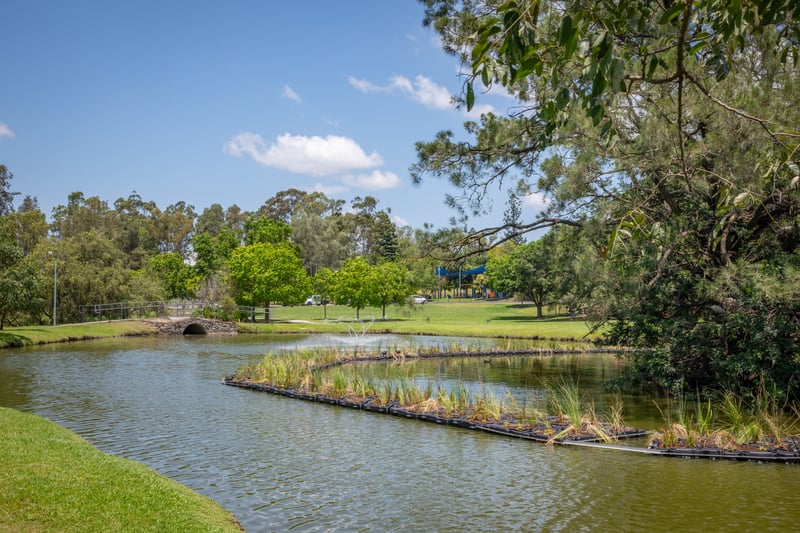
Thriving floating wetlands at Lake Alford Park. Image credit: Gympie Regional Council
The wetlands were engineered to behave differently in floods. Rather than being fixed to the shoreline with limited movement, they are tethered in place but designed to remain buoyant and stable as lake levels rise by up to eight metres, enabling the system to cope with floods approaching one in 100-year levels.
Anchors prevent them from breaking free and being swept into the downstream river. If the floating wetland vegetation is damaged by extreme events or bird activity, the modular system allows rapid replanting or even relocation of sections, extending their life and value. This pioneering modular system is the first of its kind in Australia.
Landscaped edge treatments
After the floods, Lake Alford’s banks were unsafe. Every chunk of bank that disappeared added to the sediment load heading for other waterways. Around the collapsing lake edge, we designed three complementary treatments to stabilise the banks and shape how people and wildlife move.
At sections with significant water flow, we introduced a fixed edge using sandstone blocks to secure the shoreline in place. Importantly, these fixed edges were not wrapped all around the lake but were used in places where erosion and safety risk were greatest, keeping much of the lake feeling like a natural shoreline.
In other sections, we used garden beds as a softer stabilisation measure. A layer of rock ties the soil together at the waterline, while dense planting binds the bank and slows overland flow. Importantly, they address a key ecological risk for the birdlife. Rather than hard edges, these rocky shorelines act as ramps where ducks, geese and swans can easily move between land and water.
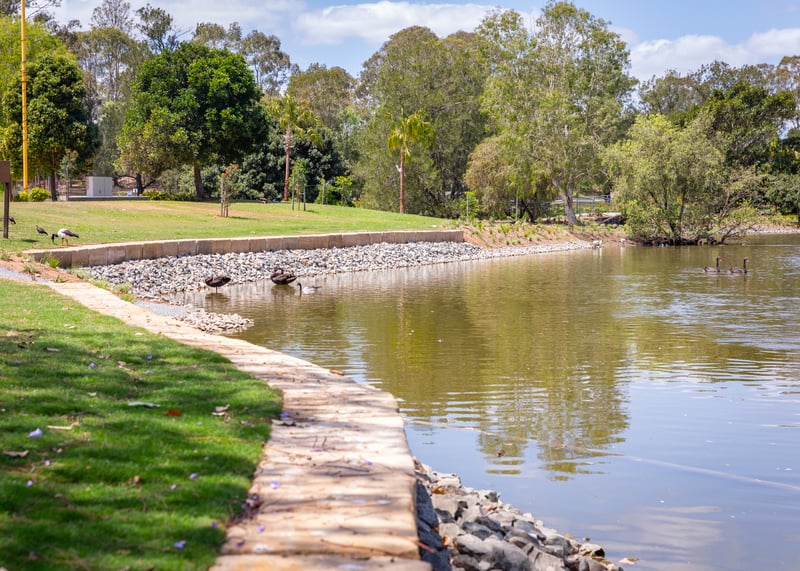
Completed landscaped edge treatments at Lake Alford Park. Image credit: Gympie Regional Council
In selected zones, the edge was rebuilt using a benched wetland approach, each set at a different elevation and planted with species suited to that depth range. The chosen planting accommodates dry periods, where some benches may be exposed; but in wetter times, when inundated, the plants’ root systems continue to stabilise soil and provide habitat. As water levels rise, they dissipate water energy and trap sediment runoff.
For councils, our insight is clear: think in systems. Ask how pumps, pipes, wetlands, planting and edges can work as one hybrid flood-resilient landscape.
3. From park users to ecosystem influencers
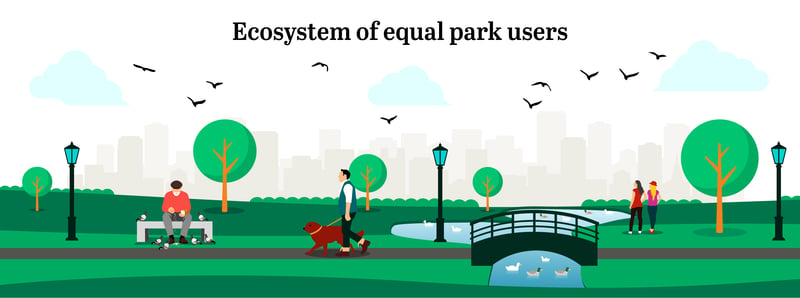
We treated people, birds and aquatic life all as equal users in our design.
Plants were selected based not just on performance, but also ecology. Species for the wetlands were chosen for their ability to thrive in local conditions and downstream waterways. Edge treatments considered how birds would enter and exit the lake, so we didn't interrupt natural access routes or nesting.
Equally essential was understanding how the community already used the park. We weren’t designing a community asset from scratch. We observed natural human behaviour. Favoured viewpoints and walking routes informed our placement of sandstone blocks for new opportunities for rest and observation. We created accessible, shaded places without compromising our main mission of flood performance.
For other councils: seeing a park as an ecosystem, which includes people and preestablished behaviours, helps ensure resilience measures have public support rather than resistance. Restoration works are an opportunity to increase everyday amenity and biodiversity, not just install infrastructure.
4. From project delivery to community legitimacy
Even the best technical solution will struggle without transparency and trust. With Council, we invested heavily in communication and collaboration.
Close coordination between engineers, arborists, ecologists, contractors and council officers allowed sensitive decisions on tree protection and trenching to be made quickly. Site teams were empowered to pause works and escalate concerns, protecting assets and forming new good working relationships for Council.
For the community, we explained unfamiliar new features like the floating wetlands. On-site, easily interpreted visual materials helped build understanding of why works were happening whilst explaining the benefits.
The payoff has been strong public support, higher patronage and national recognition –positioning Gympie as a leader in flood-resilient park design.
Our insight for councils: keep your stakeholders and the community communicated, engaged and empowered.
Designed to perform in future floods
The Lake Alford upgrades were designed and engineered around known lake levels and flood behaviour so the park can function day‑to‑day and still cope with major events. The edge treatments are set above normal water levels so paths and leisure spaces remain usable in typical conditions. However, they can be safely overtopped in heavy rain, helping protect banks from erosion and supporting a quicker return to normal use after floods.
Planting and the floating wetlands were chosen for their known ability to tolerate temporary flooding and submersion and keep improving water quality over time, rather than needing to be rebuilt after each event.
As these systems mature, they are expected to strengthen bank stability, support bird and aquatic life and maintain clearer, healthier water, so Lake Alford can stay a cleaner, safer and more welcoming place for the community even as future floods occur.
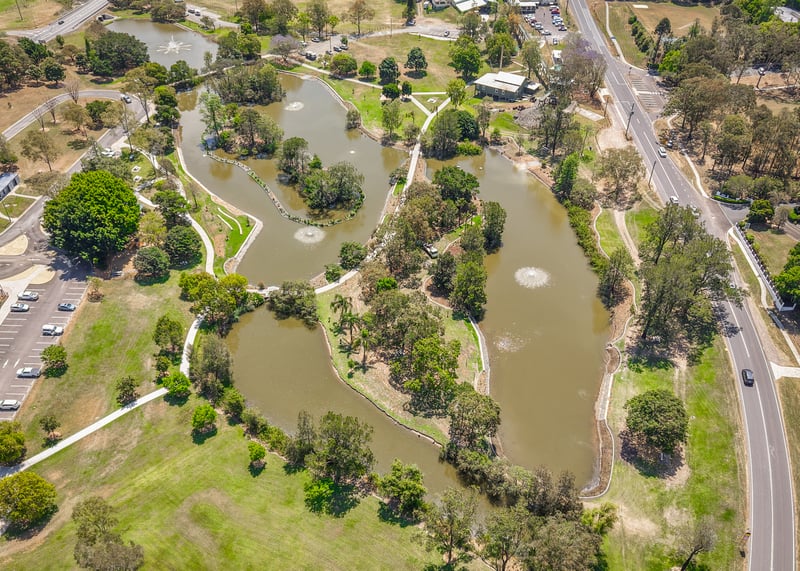
A flood-restored, thriving Lake Alford Park with renewed water circulation, floating
wetlands and landscape edge treatments. Image credit: Gympie Regional Council
What this means for your next flood-damaged community asset
The biggest mistake would be to do what has always been done, get back to normal as quickly as possible.
Floods will remain a constant. The question for your council is whether each event leaves the asset in a more vulnerable state, or whether its restoration can be the catalyst for creating a space that is more resilient, biodiverse and loved by people.
This article was first published by Aecom. You can find the original here.
Share