



Week in water: updates from across the community
 by Water Source
This week’s water sector activity focused on climate resilience, infrastructure planning and water efficiency, with utilities, researchers and industry organisations progressing work aimed at strengthening water security, supporting growing communities and improving long-term environmental outcomes.
From wetland adaptation planning and major sewer upgrades to school water monitoring, rainfall research and new reservoir infrastructure, the latest developments reflect the sector’s ongoing focus on sustainability, reliability and climate readiness.
NATIONAL
New study assesses climate risks for Basin wetlands
A new study has assessed the impacts of climate change at three internationally significant Ramsar wetlands in NSW, South Australia and Victoria, helping to guide future environmental management.
The Murray-Darling Basin Ramsar Climate Change Vulnerability and Adaptation Project has been undertaken by the Department of Climate Change, Energy, the Environment and Water and CSIRO since 2023, focusing on the Macquarie Marshes, Riverland and Barmah Forest Ramsar sites.
The study found that in the short term, the most significant climate change challenge for the wetlands is increased pressure on already irregular flows of water. In the long term, hotter and drier conditions are expected to introduce new pressures and amplify existing threats.
Minister for the Environment and Water Murray Watt said: “This $2.5 million project is helping us to understand the short and long term challenges, and be in a position to take meaningful action to manage the risk of Ramsar sites like the Macquarie Marshes and other significant wetland sites being damaged by climate change.
“This research will give communities and wetland managers the clear, evidence-backed answers they need to understand how to best protect Australia’s beloved wetlands from the challenges of climate change.”
Aurecon announces Water and Environment leadership appointments
Aurecon has announced three Water and Environment leadership appointments to support clients and industry to navigate complex water requirements and environmental risks.
Julie Harrison has been appointed Managing Director, Water & Environment, Nick Quinn has been appointed Water Leader, Australia, and Braith Gilchrist has been appointed Environment Leader, Australia.
Aurecon said water utilities and industrial asset owners are facing pressure from population growth, industrial requirements, reduced natural water supply and ageing infrastructure requiring significant investment.
Aurecon Chief Executive, Australia, Todd Battley said: “The complexity of water security and management for industries, such as data centres and resources, is significantly impacting productivity and profitability. And environmental risk is directly influencing whether large, complex water, energy and transport projects can be delivered at the pace and scale required for economic growth.”
STATE AND TERRITORY
Unitywater celebrates Harmony water reservoir
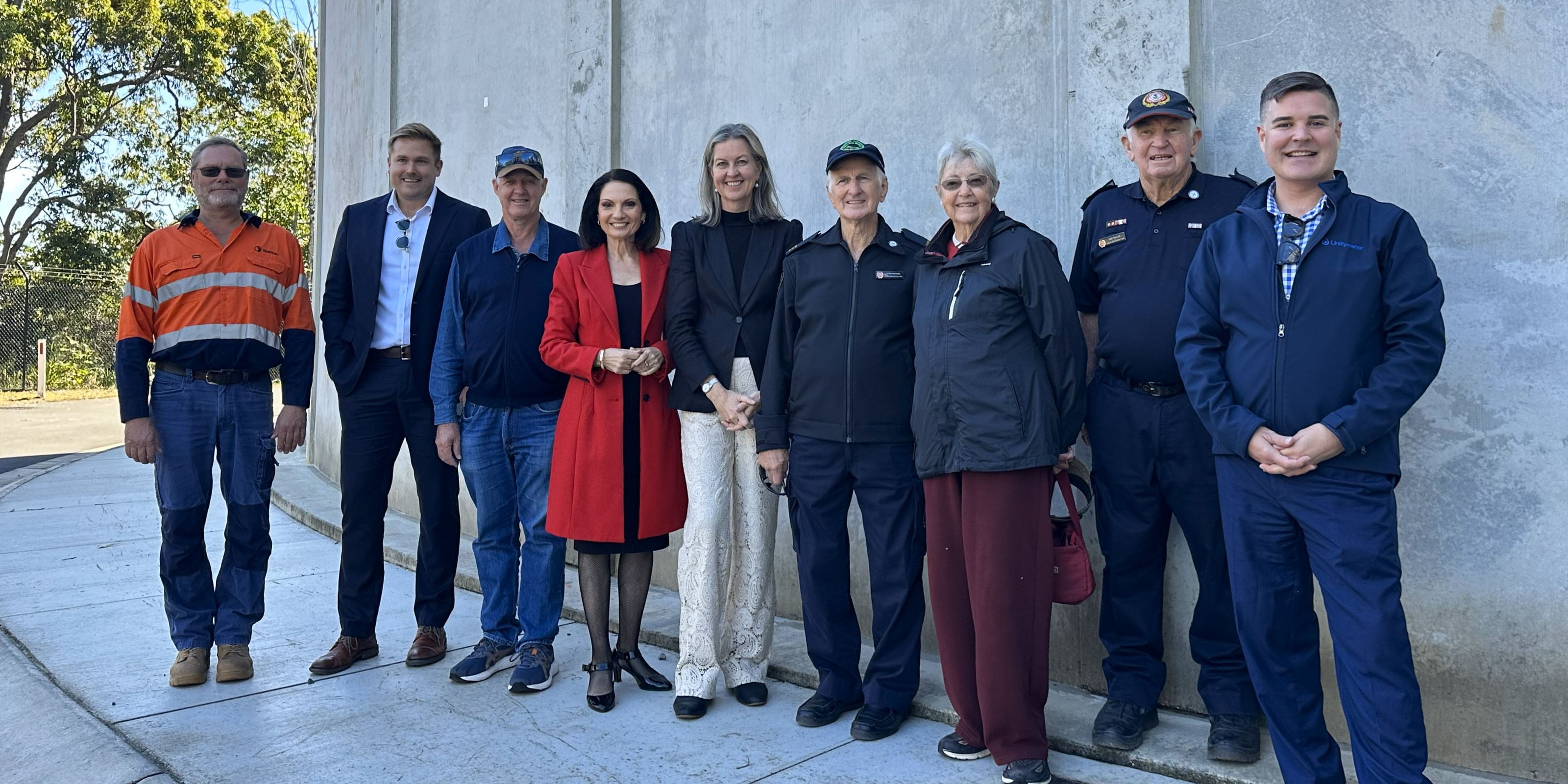
Unitywater has hosted a commissioning celebration for a new 12-megalitre water reservoir at Tanawha that will service 21,000 residents set to live in Harmony by 2036.
The Harmony Water Reservoir is the newest piece of major water infrastructure on the Sunshine Coast, standing at 10 metres high and 40 metres across.
Unitywater CEO Anna Jackson said: “We provide essential, safe, reliable and sustainable water and wastewater services, and this asset is part of our broader Aura and Harmony capital delivery program to cater for these growing communities.”
The reservoir is now supplying water to homes in Harmony through a 2.6-kilometre pipeline. The broader Aura and Harmony Program will deliver 27.6 kilometres of water and wastewater pipelines, two large water reservoirs and a new wastewater pump station.
Smart water data delivers savings for Gippsland schools
Gippsland Water is encouraging local schools to take advantage of a water monitoring program that can help reduce water loss and cut costs.
The Schools Water Efficiency Program is a Victorian State Government initiative that supports schools to track water use and detect issues through digital metering technology.
Earlier this year, Lowanna College detected a major on-site leak through the program. If left unchecked, the leak could have wasted more than 21,600 litres of drinking water every day, costing the school around $611 per week in avoidable water charges.
Gippsland Water Managing Director Sarah Cumming said: “Real time data helps schools spot problems early and avoid unnecessary water costs.”
TasWater expects restrictions to ease after rainfall
TasWater is confident water restrictions will be lifted across most of Tasmania next week, as monitoring continues following recent rainfall.
The anticipated easing of restrictions comes after welcome rain across much of the state, especially in areas that needed it most.
TasWater Head of Communications and Engagement Liz Hafner said: “The recent rain has been extremely welcome, and improvements to supply levels in most of our catchments are looking extremely positive.
“However, after such an extended dry period and heavy rainfall, we want to make sure systems have recovered properly and that water quality remains at the standard our communities expect before any further decisions are made.”
Restrictions are expected to be lifted in Orford and Triabunna, Oatlands, Scamander and Whitemark, while Lady Barron on Flinders Island is expected to remain on Stage 1 water restrictions until further notice.
Final stage begins on CBD sewer upgrade
Greater Western Water’s $160 million project to expand Melbourne’s oldest sewer network is another step closer to completion, with major works underway for the fourth and final stage.
The works will see about 750 metres of underground sewer pipes constructed along Siddeley Street, connecting them to the existing network. The expansion forms part of GWW’s Melbourne CBD Sewer Strategy, a major investment to strengthen Melbourne’s wastewater infrastructure.
GWW General Manager Asset Planning and Delivery Ian Burton said: “Melbourne’s underground sewer network has played a crucial role in protecting public health and the environment for the past 120 years.
“These are vital works designed to strengthen the sewerage system’s capacity and reliability as Melbourne CBD’s population continues to grow and thrive.”
Works on the final stage are expected to be complete by 2028.
Monash study sheds light on Victoria’s future rainfall
New research led by Monash University has provided a new perspective on forecasts of future rainfall in Victoria, showing that recent dry conditions may not fully reflect long-term climate change signals.
The study, published in Theoretical and Applied Climatology, highlights the role of natural climate variability in shaping recent rainfall patterns and how this influences expectations for the future.
Research by Scott Power, Adjunct Professor at Monash University’s School of Earth, Atmosphere and Environment and the University of Southern Queensland, found that how we interpret future rainfall depends on both climate model projections and how unusual recent decades have been.
Professor Power said: “While many aspects of climate change are clear and well-established, including rising temperatures, sea levels, and more frequent heatwaves, regional rainfall is different.
“This difference arises because natural rainfall variability can be large relative to the impact of greenhouse gases on rainfall.”
Irrigation demand drops in 2025/26 season
The 2025/26 irrigation season saw the third lowest water deliveries across the Goulburn-Murray Irrigation District in the past 10 years.
The season ended on 15 May 2026, with 79,000 orders processed and more than 850,000 megalitres of water delivered to private irrigators. The 10-year average is 1,007,000 megalitres.
GMW General Manager Water Delivery Services Warren Blyth said lower inflows into storages were contributing to a drop in irrigation demand.
“Our customers are continuing to face challenges due to dry and variable conditions” he said.
“Timely rainfall did arrive throughout the 2025/26 season but not at the levels we need for substantial flows into storages.
“Some of our storages, in particular the ones in the Goulburn, Campaspe and Loddon systems, are at 40 per cent or lower.”
GMW is undertaking improvements to channels, pipelines and regulators during the current Winter Works period.
INTERNATIONAL
Study maps changing rainfall and flood exposure
Researchers from Wuhan University have examined how climate change is reshaping the geography of heavy rainfall, with some regions facing far greater flood risk than others.
The study used climate models under high-emissions and moderate futures to map how far daily rains over 50 millimetres could spread, before overlaying shifting population maps onto those expanding storm areas.
The research found that under the worst-case warming scenario, heavy-rain areas grow almost three times faster than under a milder scenario. However, population exposure grew fastest under the moderate-warming pathway.
The findings, published in Earth’s Future, highlight the importance of regional planning as climate change redraws rainfall patterns and changes future flood risk.
Want water sector insights delivered weekly? Subscribe to Source, the Australian Water Association’s newsletter.



%20(1).jpeg?width=352&name=Hunter%20Water%20aerating%20water%20pumped%20from%20the%20Tomago%20Sandbeds%20before%20treatment%20and%20supply%20to%20the%20network%20(1)%20(1).jpeg)