Week in water: updates from across the community
 by Water Source
This week’s water sector activity focused on affordability, climate resilience, water security and infrastructure investment, with utilities, researchers and governments continuing to respond to growing pressure on water systems and essential services across Australia and internationally.
From regional drinking water upgrades and tougher water restrictions to emissions planning, digital metering and emerging research into climate adaptation and hydrogen production, the latest developments reflect the sector’s ongoing focus on reliability, sustainability and long-term resilience.
NATIONAL
Mott MacDonald to acquire Leed Engineering & Construction
Global engineering consultancy Mott MacDonald has entered into an agreement to acquire Australian civil contractor Leed Engineering & Construction, strengthening its integrated water infrastructure delivery capability across Australia.
Leed Engineering & Construction specialises in complex infrastructure projects across water, dams, environmental works, roads and bridges, with more than 350 staff operating across South Australia, Victoria and New South Wales.
Mott MacDonald said the acquisition would allow the businesses to offer fully integrated design and construction services, particularly for water infrastructure provision and remediation projects.
Mott MacDonald Regional Managing Director for Asia Pacific, New Zealand and Australia Adrian Jones said the move responds to growing infrastructure demand across the country.
“There is a significant demand for new and upgraded infrastructure across Australia and particularly in the water sector,” he said.
“By combining the capabilities of Mott MacDonald and Leed it takes our technical expertise to the next level, enabling us to provide a fully integrated design and construction offering to our clients in this space.”
STATE AND TERRITORY
TasWater pricing and service plan approved
TasWater’s fifth Price and Service Plan has been approved by the Tasmanian Economic Regulator, setting prices and service levels for the four years from 1 July 2026 to 30 June 2030.
Under the plan, residential water and sewer bills will increase by 5.7% annually, with the average household expected to pay around $80 more in 2026-27. A new variable sewer charge based on water usage will also be introduced.
TasWater said the approved price increases were lower than originally proposed, meaning some infrastructure projects may need to be delayed while the utility continues prioritising critical upgrades and pursuing additional funding opportunities.
Werai Forest regulator project to begin in June
Construction works are set to begin in June on the Werai Forest Regulator Project west of Deniliquin to replace three ageing regulators and install a new regulator at Moonyah Lagoon.
The project will replace regulators at Tumudgery Creek, Reed Bed Creek and the Niemur River, supporting river connectivity, native fish movement and environmental water delivery in the Ramsar-listed forest.
The NSW Government said the project would also improve cultural heritage outcomes for Traditional Owners and help deliver commitments under the Murray-Darling Basin Plan. Construction is expected to be completed by December 2026.
Unitywater expands digital metering rollout
Unitywater’s expanded Digital Metering Program has entered its second month, with properties across Moreton Bay and the Sunshine Coast set to receive upgraded digital water meters throughout May.
The rollout includes properties in Kallangur, Murrumba Downs, Nambour, Woombye and Diddillibah, following the installation of more than 2,200 digital meters last month.
Unitywater Executive Manager Customer Experience Katherine Gee said: “We’re installing meters by ‘network blocks’, which are defined by our water supply infrastructure layout, rather than street-by-street,” she said.
“This enables us to more accurately pinpoint potential leaks in the network beyond the household level.”
South East Water installs new Choose Tap stations at Gumbuya World
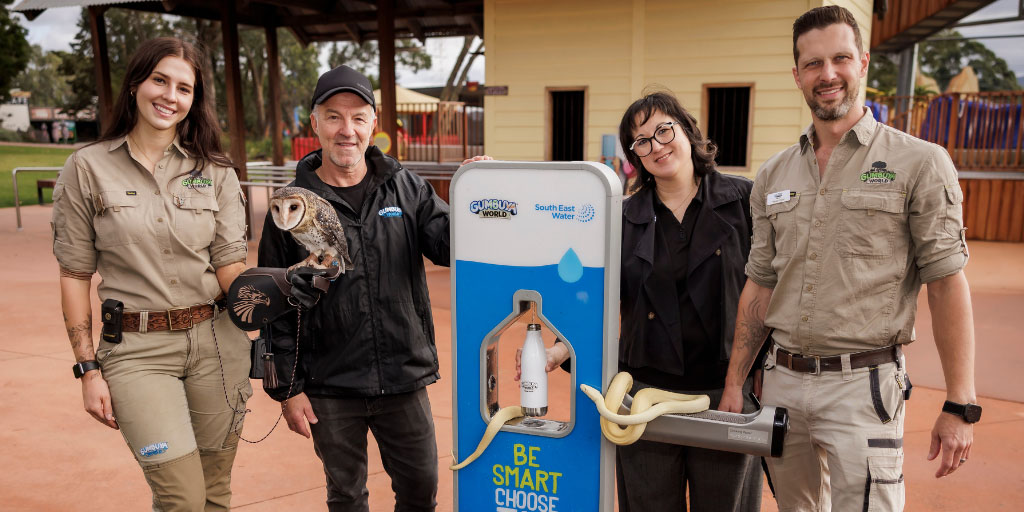
South East Water and Gumbuya World have partnered to install a new Choose Tap water station at the Victorian theme park, helping visitors access free drinking water while reducing single-use plastic waste.
The water station includes an accessible bubbler, bottle refill tap, solar lighting and a digital water meter that tracks estimated plastic bottles diverted from landfill.
South East Water General Manager Strategy and Stakeholder Karen Lau said: “We’re delighted to help visitors make a more sustainable choice by choosing tap water when they visit Gumbuya World.”
Study examines role of aquifer storage in climate adaptation
New Flinders University research has highlighted the potential for Managed Aquifer Recharge systems to improve long-term water security as climate pressures intensify.
The study examined how rainwater, stormwater and treated wastewater can be stored underground to replenish groundwater supplies and support more climate-independent water systems.
Lead author Dr Constantin Seidl said: “While demand for water is increasing in most countries, new management strategies and novel water infrastructure are needed, like MAR and water sensitive urban design, to more sustainably manage existing water resources.”
“Despite being well-understood from technical, hydrological and engineering aspects, MAR policy frameworks are not being advanced to provide for cheaper and more effective capture of water in more environmentally friendly ways than building new dams,” he said.
Hunter Water urges conservation amid rising demand
Hunter Water is encouraging customers to make Smart Water Choices after the Lower Hunter recorded its highest April water usage in 20 years.
Residential water use exceeded 3.7 billion litres during the month, with drinking water storages falling to around 62%, their lowest level in more than five years.
Hunter Water Executive Manager Strategy and Engagement Emma Berry said: “We can’t control the weather, but we can control how much water we use. Every day is a good day to save water, and right now it’s more important than ever.”
Oatlands moves to stage 2 water restrictions
TasWater will introduce Stage 2 water restrictions in Oatlands from 20 May following ongoing dry conditions and declining dam levels. The restrictions aim to reduce non-essential water use by 50% and include allocated watering days and a ban on lawn watering.
TasWater Head of Communications and Engagement Liz Hafner said: “Continued low rainfall and declining dam levels have made it essential to escalate restrictions in Oatlands.”
“We know restrictions are challenging, but with the possibility of an extended drier period forecast later this year, every litre saved now helps protect the community’s water supply in the months ahead,” she said.
Yarra Valley Water launches community bill support pop-ups
Yarra Valley Water is bringing face-to-face financial support services to communities across Melbourne’s north and east through a series of bill support pop-up events.
The sessions will be held across Darebin, Manningham and Banyule, helping customers access concessions, grants and flexible payment support.
Yarra Valley Water General Manager Retail Services Lisa Anelli said: “Being present in our communities really matters to us. We know cost of living pressures are affecting many households, and we want our customers to know they’re not alone and that support is available.”
Jurien Bay water security project underway
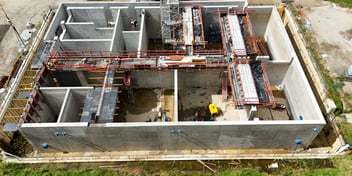
Construction is underway on a $23 million project to strengthen Jurien Bay’s drinking water supply and improve long-term reliability as climate pressures increase.
The project includes commissioning a deeper groundwater bore, constructing a two-kilometre pipeline and building a new water treatment plant, increasing the town’s annual water supply capacity by 24%
Federal Minister for the Environment and Water Murray Watt said: “We know that climate change is placing increasing pressure on traditional water sources across Australia, particularly in regional communities that rely on shallow groundwater.”
“That’s why, through the National Water Grid Fund, the Australian Government is partnering with the Cook Labor Government to invest in practical water infrastructure that supports resilient regional communities now and into the future,” he said.
Wellington East to receive treated drinking water supply
Around 220 homes in Wellington East will soon receive treated drinking water supplied by SA Water as the township transitions from untreated River Murray water to SA Water’s network.
The project includes connecting the community to the Lake Alexandrina trunk main and disinfecting the existing network before final water quality testing is completed with SA Health.
SA Water General Manager Customer, Community and Engagement David Coombe said: “Following completion of the pipe disinfection and cleaning phase, together with SA Health, we will undertake extensive water quality testing to ensure the supply is safe and suitable for drinking.”
“While the water may appear clear during this time, it must not be consumed until SA Health declares the water quality as safe, and we notify impacted residents,” he said.
INTERNATIONAL
Researchers develop lower-temperature hydrogen production method
Researchers from the University of Birmingham have developed a new low-temperature method for hydrogen production that could support both large-scale and localised clean energy generation.
The research demonstrated that a perovskite catalyst could produce hydrogen at significantly lower temperatures than traditional thermochemical splitting methods, potentially allowing industrial waste heat to be reused for hydrogen production.
New sunlight-driven method targets toxic wastewater pollution
Researchers in Birmingham have demonstrated a new photocatalytic method for removing toxic industrial dyes from wastewater using sunlight and ultra-thin sustainable catalysts.
The research focused on addressing pollution from industries including textiles, cosmetics, food production and pharmaceuticals, with textile dyes remaining one of the world’s largest contributors to water pollution.
Want water sector insights delivered weekly? Subscribe to Source, the Australian Water Association’s newsletter.