 by Cecilia Harris
Sydney Water’s multibillion-dollar infrastructure program isn’t just a construction boom – it’s a response to increasing pressure on multiple fronts. Here, Sydney Water’s new Head of Major Project Delivery, Deanne McDonald, shares how strategic planning and partnerships are laying the groundwork for long-term resilience.
McDonald is well positioned to speak about what this investment boom looks like in the pipeline, but also the reasons for the present surge.
"There are four main drivers behind the momentum we're seeing now. First, there’s ageing infrastructure. We’ve benefited from investments made 50 years ago, but much of that infrastructure is now in need of upgrading or expansion,” she said.
“Second, population growth is a key driver. As demand for new homes increases in Greater Sydney, we’re seeing a rise in greenfield developments and the need for supporting infrastructure to keep pace.
“We work closely with the government to align with their priorities. One of our biggest drivers is housing, supporting the delivery of 377,000 new dwellings under the government's housing agenda.”
Furthermore, compliance requirements have become far more stringent, especially where water is returned to natural systems like rivers or the ocean.
“Ensuring water and wastewater treatment meets Environmental Protection Licence (EPL) standards is vital. That includes having the right technology at our plants and building adequate reservoir capacity,” McDonald said.
“And finally, we tend to run counter-cyclically to sectors like transport. Every 10 years or so, we have more opportunity to deliver because there’s more capacity in the market.
“That market capacity shift enables us to move forward.”
Leading up
Sydney Water has spent the last three years developing strong relationships with contractors, suppliers and vendors, McDonald said, all in preparation for delivering on a dizzying capital works portfolio.
“We've introduced relationship contracts and now use NEC4 instead of GC21, focusing on collaboration with our delivery partners. That helps us ensure the market has the capacity to deliver the volume of work we're planning,” she said.
“We also have a Long-Term Capital Operating Plan (LTCOP), which maps out our priorities over the next 10 years across the Sydney Water network.
“We’re working with IPART to shape the capital investment for the next five years, and we'll continue to work with the community to prioritise projects.”
Significant investments are already committed, McDonald said, including for the Advanced Water Recycling Centre (AWRC): “we’re building the AWRC at Upper South Creek. We've put about $1.5 billion into building the networks required to deliver wastewater to that plant. We're also doing stormwater work in Western Sydney around the Aerotropolis”.
“Additionally, we’re upgrading several water resource recovery facilities, what we used to call wastewater treatment plants. These upgrades are necessary due to growing catchments and stricter compliance standards,” McDonald said.
“There’s also a separate, dedicated program focused on renewals and smaller projects delivered through our regional delivery partners across three geographic areas. The volume of work is why building strong market and supply chain relationships has been so important.”
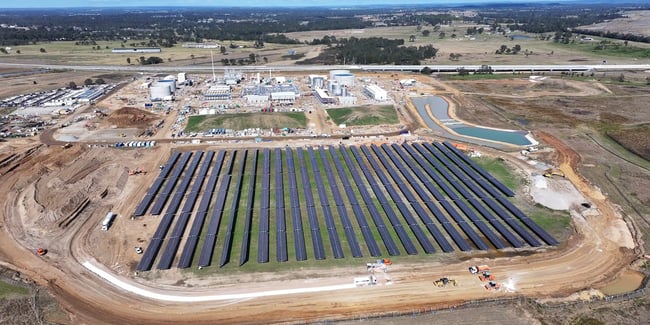 Sydney Water's AWRC solar farm at Upper South Creek.
Keeping up
McDonald said that all utilities plan decades in advance, and project delivery prioritisation is always a balance of careful planning and flexibility.
"We plan 20 to 50 years ahead. We build assets that might last 50 or even 100 years, so we need to think long-term and work backwards from there,” she said.
“Take the AWRC at Upper South Creek. That’s a project 15 years in the making. Conversations about the area started long before the airport plans were confirmed. Once that was locked in, we planned a scalable advanced water recycling plant. Then we worked out how many people it could service and when it would need to be expanded.”
McDonald said matching capital investment to actual need is a big part of the job.
“We’ve got investment managers focused on funding, planners looking at demand and timelines, and delivery teams working on approvals and construction,” she said.
“Across that whole value chain, there's tight coordination. Affordability is always front of mind; we know people can’t live in houses without water and wastewater services. But we also have to balance that with the cost to customers.
“We work closely with the government to understand zoning and development timelines and try to align our work with their strategy. That can be challenging, especially with dispersed developments or smaller projects.”
In the pipeline
Of the array of various projects planned or already in the delivery pipeline at Sydney Water, McDonald said she is particularly excited about the AWRC at Upper South Creek.
“It’s the first greenfield wastewater treatment plant we’ve built in a long time, and it's truly innovative. It’s designed to supply recycled water, has a brine pipeline, and returns water to rivers. It's also a circular economy hub, half-powered by its own solar array,” she said.
“We've done some really interesting First Nations engagement and revegetation around the site, which was formerly paddocks. The project's going well, and we have a fantastic team and contractors.
“The networks leading to the plant have also been interesting. We've approached them from a systems perspective, looking at five different projects and catchments to see how we could reduce costs and impacts.”
At the core of successful project management is delivering on time, on budget and to scope, McDonald said: “But beyond that, success is about providing affordable services to customers”.
“It’s about pushing the dial, looking at how to make infrastructure more economical, more predictable. How can we reduce impacts during delivery? Things like manufactured components and modular construction help with that.
“We want infrastructure that’s scalable and future-ready, where we can build on the foundation with new technologies. Every decision must come back to customer benefit. They’re paying for it, so the return needs to be there over time.
“But everything has a cost and requires prioritisation. We can’t do everything at once. The key is to narrow the field and keep improving, step by step.”
Share