Week in water: updates from across the community
 by Water Source
This week's water sector activity focused on environmental water planning, supply security, infrastructure investment, community engagement and research, with organisations preparing for changing conditions while delivering benefits for customers and ecosystems.
From Basin-wide environmental priorities and major irrigation infrastructure to drinking water upgrades, digital metering and new approaches to water decontamination, the latest developments demonstrate the breadth of work underway across the sector.
NATIONAL
Environmental water plan prepares Basin for drier conditions
The Commonwealth Environmental Water Holder has released its 2026-27 Water Management Plan as warmer and drier conditions are forecast across much of the Murray-Darling Basin.
The plan will guide the delivery of environmental water to support rivers, wetlands, native fish, waterbirds and vegetation under varying climate scenarios.
Commonwealth Environmental Water Holder Dr Simon Banks said successful environmental watering across the northern Basin, Upper Murrumbidgee, Goulburn River and Macquarie Marshes during 2025-26 had helped build ecological resilience.
Priorities for the coming year include maintaining river connectivity, supporting native fish, waterbirds and vegetation, protecting refuge waterholes and building the resilience of internationally important wetlands.
“Delivering water is only part of the story. We are also enabling projects that help environmental water go further and achieve better outcomes on the ground,” he said.
STATE AND TERRITORY
Students take to the court for Unitywater Lightning Cup
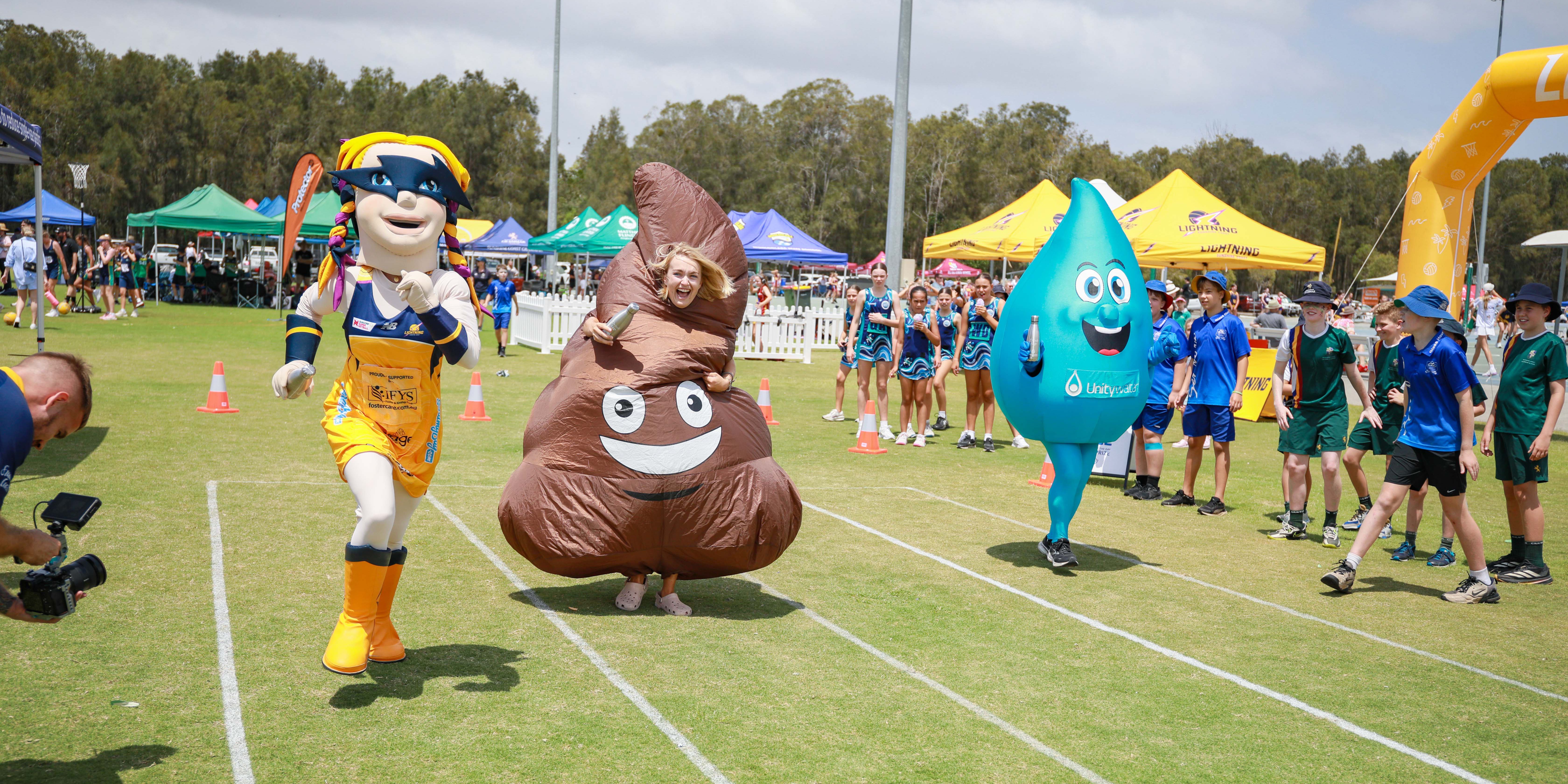
More than 1,000 primary school students competed in the annual Unitywater Lightning Cup at the Maroochydore Multi-Sports Complex.
The event brought together 112 teams from schools across Moreton Bay, the Sunshine Coast, Noosa and Gympie for a full day of netball, including inclusive multiclass clinics.
Unitywater CEO Anna Jackson said: “It’s easy to fill up and show up, just like the amazing Lightning players, by refilling your reusable water bottle to stay healthy and hydrated.”
Mount Bold releases water after record rainfall
Water flowed through the spillway gates at Mount Bold Reservoir for the first time in almost four years following record rainfall across Adelaide.
The reservoir captured more than 13 billion litres of water over the weekend, increasing from 69% to about 95% of capacity and triggering a controlled release into the Onkaparinga River.
SA Water Senior Manager Environment and Energy James Crocker said: “Dam walls, gates and spillways are designed to manage water within a reservoir in a controlled manner, to ensure we can protect the structural integrity of the dam and its surrounding communities.”
Kadjina water upgrade lifts long-standing advisory
Residents of Kadjina in Western Australia’s Fitzroy Valley can safely drink tap water and use it for food preparation following the completion of a $1.9 million infrastructure upgrade.
A long-standing water quality advisory, which had been in place since 2017, was lifted after an eight-month proving period for the community’s new water treatment plant.
Water Minister Daniel Pastorelli said: “While drinking tap water is something most of us take for granted, Kadjina's new water treatment plant means residents can have confidence in the quality of their drinking water supply.”
Water fountains celebrate Country and community
Two new water fountains have been installed at IKON Park through the Choose Tap initiative, delivered in partnership with Greater Western Water.
The fountains feature artwork by Yankunytjatjara, Kokatha and Wirangu woman Shelley Ware, an educator, media presenter and Chair of the Carlton Football Club’s First Nations Cultural Committee.
Ware said: “It is a real honour to have my artwork featured on these water fountains at IKON Park. The design celebrates the importance of water, Country and community connection. It features Bunjil, the Wedge-tailed Eagle, the Creator Spirit of the Wurundjeri Woi-wurrung people, who watches over and guides us today.”
Danielle Roche appointed to lead Goulburn Valley Water
Danielle Roche has been appointed Managing Director of Goulburn Valley Water and will commence in the role on 9 September 2026.
Roche has more than 20 years of experience across the water and energy sectors, including senior roles at AusNet Services, Queensland Urban Utilities, Veolia Water Technologies and City West Water.
Goulburn Valley Water Board Chair Mark Stone said: “Danielle's deep experience in asset-intensive, regulated utility environments, combined with her track record in digital transformation, commercial management and building high-performing teams, were particular strengths identified by the Board.”
Eucalypt plantation expands to support Sydney koalas
Sydney Desalination Plant and Veolia are expanding an eucalypt plantation at Kurnell to 2,000 trees, providing a sustainable food source for koalas in the care of Symbio Wildlife Park.
The initiative builds on an initial plantation established in 2020 and forms part of more than $100,000 invested annually in environmental projects at the desalination plant.
Sydney Desalination Plant CEO Philip Narezzi said: “We are incredibly proud to manage more than just drinking water infrastructure, we are caretakers of this unique coastal environment.”
Final pipeline laid for Northern Midlands scheme
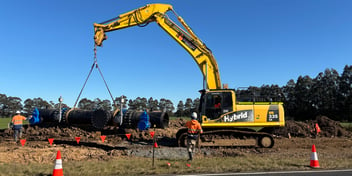
The final section of pipeline has been laid for the Northern Midlands Irrigation Scheme, completing its 152.4-kilometre pipeline network. The $217.96 million project will provide 25,500 megalitres of highly reliable irrigation water each year to about 50 irrigators across Tasmania’s Northern Midlands.
Tasmanian Irrigation CEO Mike Sylvester said: “More than just pipes in the ground, this project is about water security for generations of Tasmanian farmers.”
The project team is now commissioning and testing pipelines and property outlets ahead of water delivery commencing in October 2026.
Smart rain gardens improve stormwater treatment
UNSW researchers have developed an adaptive stormwater treatment system using sensors, automated controls and weather forecasts to improve pollutant removal.
The technology allows rain gardens to monitor internal conditions and prepare for forecast rainfall by releasing stored water before a storm, creating capacity for incoming runoff.
Laboratory testing found the system increased the removal of many organic contaminants from about 76% to almost 90%, while also improving the treatment of nitrogen, organic carbon and other common pollutants.
Lead researcher Jiadong Zhang said: “It's a bit like giving a rain garden the ability to think ahead.Ultimately, if we can stop more pollutants entering rivers and the ocean, that benefits the environment, wildlife and the communities that use those waterways.”
Beveridge sewer upgrade supports northern growth
Yarra Valley Water has completed the final stage of its Rankin Street Sewer Project, upgrading the Mandalay Sewer Pump Station in Beveridge.
Delivered in partnership with Jaydo, the upgrade increases the capacity and resilience of the local sewerage network to support one of Melbourne’s fastest-growing areas.
Yarra Valley Water Deputy General Manager Asset Delivery and Care Simon Willis said: “Completing this upgrade means the network is ready to support current and future demand, while the innovative delivery approach helped minimise impacts on nearby residents.”
TasWater investigates thefts from critical sites
TasWater is investigating a series of thefts from water and sewerage sites across Greater Hobart and the Derwent Valley. Aluminium pit lids, reservoir hatches, ladders and safety railings were stolen, creating safety risks and exposing essential assets to potential damage.
TasWater General Manager Operations Brendan Windmeyer said: “Stealing infrastructure from critical public assets is unacceptable and creates significant safety risks for our people and the wider community.”
The thefts have not affected water quality, but TasWater crews have been diverted from planned maintenance and improvement work to replace the stolen infrastructure.
Coliban Water increases rural allocation to 100%
Coliban Water has increased its allocation for the 2026-27 rural irrigation season from 60% to 100% for all licensed rural customers.
The increase follows substantial rainfall across already wet catchments and significant inflows into storages near Kyneton. Coliban Water’s storages are now at 100% capacity, holding about 70 gigalitres.
Coliban Water Executive Manager Strategy Adam Crameri said: “The rural allocation is determined on the available water resources and in accordance with our drought response planning. Pleasingly, in recent weeks we’ve had a lot of rainfall across our already wet catchments, which has translated into significant inflows into our storages near Kyneton.”
Customers invited to shape Yarra Valley Water plan
More than two million residents and businesses across Melbourne’s north and east are being invited to help shape Yarra Valley Water’s next five-year plan.
Yarra Valley Water Managing Director Natalie Foeng said: “Melbourne is growing, climate conditions are changing and community expectations continue to evolve.”
The engagement program also includes a Citizens’ Jury comprising 45 customers selected to reflect the diversity of Yarra Valley Water’s service area. Participants will meet across six sessions from August to December 2026, followed by a recall session in March 2027.
INTERNATIONAL
Greener processing reduces water treatment material costs
University of Birmingham researchers have developed a greener and more cost-effective process for producing a material designed to remove heavy metals from industrial wastewater.
The metal organic framework has a cage-like molecular structure with a large internal surface area that can selectively capture dissolved metals, including lead.
Lead researcher Dr Swaroop Chakraborty said: “By redesigning one processing step, we were able to recover much more of the material, lower its estimated production cost while retaining its strong lead-capture performance under environmentally relevant conditions.”
Want water sector insights delivered weekly? Subscribe to Source, the Australian Water Association's newsletter.