Week in water: updates from across the community
 by Water Source
.jpeg "Construction has started on a new community hub at Wollert Community Farm.")
This week’s water community activity focused on water security, essential infrastructure, community access, innovation and workforce development.
From national discussions about remote water services to major storage and treatment projects, the latest developments highlight efforts to strengthen resilience, improve environmental outcomes and build sector capability.
NATIONAL
Report identifies safe drinking water gap in First Peoples communities
A new Water Services Association of Australia report has found more than 6,500 First Peoples living in remote communities received water that did not meet the Australian Drinking Water Guidelines at least once during the past two years.
Released at AWA's Voices from the Bush 2026 Conference in Mparntwe, Alice Springs, the Measuring the Gap: Water in First Nations Communities report examined publicly available drinking water test results from utilities and government authorities.
WSAA Executive Director Adam Lovell said: “Access to clean, healthy and safe drinking water is a basic human right for all communities in Australia, regardless of your location.”
WSAA estimates an additional $200 million in capital investment and $50 million in operating investment will be needed over five years to reduce the highest risks.
Lovell said: “It is now past the time to act. Governments and the relevant health authorities need to consult with First Nations people and immediately agree on the right metrics to measure and address water quality issues in their communities.”
STATE AND TERRITORY
Wollert Community Farm hub underway
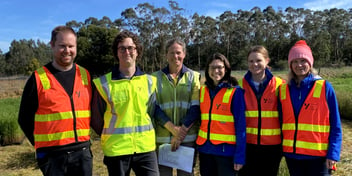
Construction has started on a new community hub at Wollert Community Farm, creating more opportunities for education, training, volunteering and connection with nature.
Supported by a $1 million Australian Government grant and funding from Yarra Valley Water and Whittlesea Community Connections, the project will expand programs around the Aurora Recycled Water Treatment Plant.
Whittlesea Community Connections CEO Alex Haynes said: “This new space will help us grow our programs, welcome more people to the site and create new opportunities for learning, employment pathways and environmental action.”
The project supports Traditional Owner-led land management and habitat restoration across 42 hectares. The hub is expected to be completed in March 2027.
Healesville treatment plant upgrade begins
Yarra Valley Water has started a major upgrade of the Healesville Sewage Treatment Plant to strengthen sewer services and improve environmental outcomes for the Yarra River.
The almost 40-year-old plant will be replaced with a facility designed to support the region through to 2056. Treatment capacity will increase by almost 80%, from about 1.4 million litres a day to 2.5 million litres.
Yarra Valley Water Deputy General Manager Asset Delivery and Care Simon Willis said: “Reliable sewer services are something our customers depend on every day, and this upgrade will ensure homes and businesses continue to receive a safe and resilient service.”
Lower Hunter water security project proposed
Hunter Water is proposing to invest more than $150 million to replace a critical 12-kilometre section of the Chichester Trunk Gravity Main between Brookfield Tunnel and Burmi Creek, near Clarence Town.
Built in 1923, the main supplies about 40% of the Lower Hunter’s drinking water. The replacement would increase the pipeline diameter from 900 mm to 1050 mm.
Hunter Water Executive Manager Infrastructure Delivery Justin Watts said: “The Chichester Trunk Gravity Main is one of the most important assets in our network, supplying around 40 per cent of the Lower Hunter’s drinking water. The project is about planning for the long-term reliability and resilience of that supply for future generations.”
The proposal is on public exhibition until 4 October 2026.
Customer committees help shape irrigation services
Members of Goulburn-Murray Water’s three Goulburn Murray Irrigation District Customer Committees are using practical experience and local knowledge to help shape irrigation services across northern Victoria.
The committees represent the district’s eastern, western and central irrigation areas.
Goulburn-Murray Water GMID Customer Committee East member Craig Reynolds said: “There’s a lot of input from Goulburn-Murray Water to give us information about things and take our feedback on how they could do things better, which they seem to be genuinely listening and wanting our feedback.”
Guidance released for Victorian water price review
The Essential Services Commission has released guidance to help 16 Victorian water businesses prepare submissions for the 2028 Water Price Review.
Businesses must outline proposed maximum prices for the five years from 1 July 2028, their customer engagement and how they will deliver their commitments.
The guidance emphasises 15-year planning and asset management, introduces an efficiency benefit sharing scheme and supports inclusive engagement, including with First Nations customers and Traditional Owner groups. Submissions are due by 13 September 2027.
Wungong Dam facilities upgraded
Water Corporation has completed upgrades at Wungong Dam in Bedfordale to make the recreation area more accessible, welcoming and family friendly.
The project delivered accessible toilets, upgraded picnic facilities, additional shade, parking, signage and improved paths. A mural by Ballardong Noongar artist Bradley Kickett, developed with local students, celebrates the area’s connection to water and Country.
Western Australian Water Minister Daniel Pastorelli said: “This upgrade will make it easier for families, older visitors, and people with accessibility needs to enjoy Wungong Dam, one of the Perth Hills’ most scenic dam sites.”
STEM program inspires future Territory workforce
Power and Water has awarded Nakara Primary School a grant through its Community Partnerships Program to support the internationally recognised FIRST LEGO League program.
Students will design, build and program LEGO-based robots over six months. The program began with 96 students from six Darwin schools, while 14 teachers joined a coaches and mentors workshop.
Power and Water Senior Manager Corporate Affairs Jane de Gault said: “Through initiatives such as our That’s My Water! schools program and our new That’s My Career! program, we’re helping to build a pipeline of future engineers, scientists, innovators and problem-solvers.”
Eurobodalla storage strengthens drought resilience
The $150 million Southern Storage Facility has been completed, strengthening drought resilience and water security across the Eurobodalla Shire.
Jointly funded by all three levels of government, the project includes a new Tuross River pump station and a 3000-megalitre storage dam near Bodalla. Water will be stored during high river flows for use when supplies are under pressure.
The facility will also deliver an additional 581 megalitres downstream for irrigation and stock watering each year. It is expected to reach capacity by mid-2027, subject to river conditions.
Federal Minister for the Environment and Water Murray Watt said: “This investment by all levels of government delivers reliability and resilience, helping to protect the Eurobodalla region against future drought and climate challenges.”
UV trial explores wastewater disinfection potential
Early results from a wastewater treatment trial at TasWater’s Perth Sewage Treatment Plant are showing promise for an emerging ultraviolet disinfection technology.
Supercritical UV spreads wastewater into a very thin layer before ultraviolet exposure, helping where colour or suspended particles limit conventional treatment. The pilot has processed more than five million litres and demonstrated strong E. coli removal under challenging conditions.
TasWater Head of Operational Support and Improvement Amanda Whelan said: “The objective is to understand both the technical performance and operational practicality of the technology, particularly at sites where traditional UV solutions may not be feasible. If successful, there is broad application across many of our sewage treatment plants.”
Want water sector insights delivered weekly? Subscribe to Source, the Australian Water Association's newsletter.


%20(1).jpeg?width=352&name=South%20East%20Water%20chlorine%20dosing%20trailer%20(1)%20(1).jpeg)
%2c%20Kate%20Deane%20and%20Shiloh%20Quilliam_BLOG.png?width=352&name=From%20L-R%20Artists%20Bec%20Adamczewski%20(Becski)%2c%20Kate%20Deane%20and%20Shiloh%20Quilliam_BLOG.png)