 by Cecilia Harris
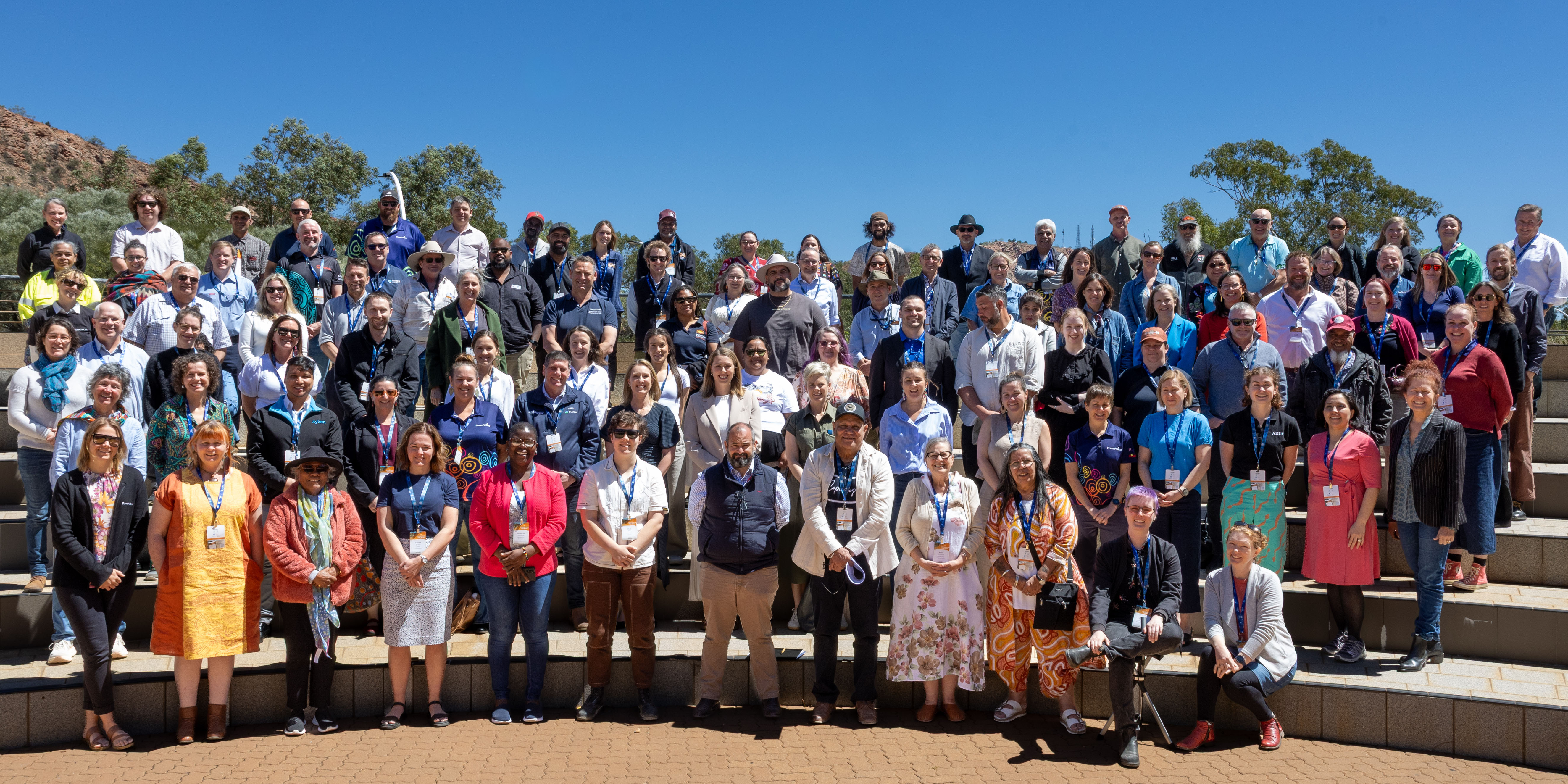
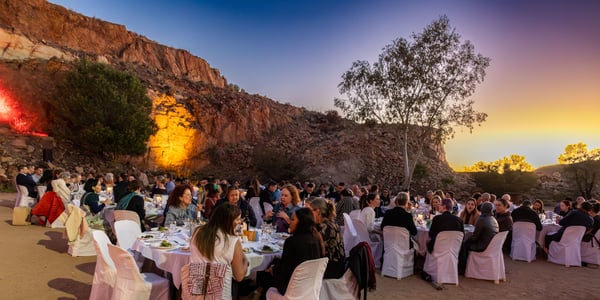
Voices from the Bush 2026 brought First Peoples, water professionals, community leaders, researchers and government representatives together in Mparntwe (Alice Springs) on Arrernte Country to share practical approaches to improving water security, equity and sustainability across rural, remote and very remote Australia.
Held over two days under the theme Stronger Together – Creating Change, the Australian Water Association conference placed First Peoples’ leadership and community experience at the centre of conversations about water services, governance, investment and resilience.
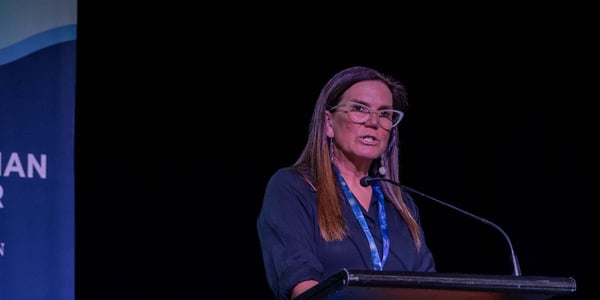
Conference Chair Nina Braid, Aboriginal Partnerships Manager at Yarra Valley Water, said the theme placed the emphasis firmly on action.
“Creating change is not just about what needs to be different, it’s about what we actually do differently,” she said.
“Voices from the Bush is a call to action. As you listen over the next few days, I want you to think about a couple of things: what can you contribute? What will you take from here and actually do when you return to your day-to-day job and to your communities?”
Braid said the conference created a space where First Peoples’ knowledge, voices and lived experiences were central to the conversation.
“I want us to move beyond truth-telling into shared decision-making and practice. I want to see lived experience driving better outcomes. I want to see two-way science creating stronger place-based solutions,” she said.
Stronger together
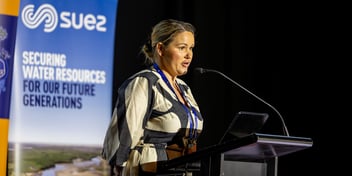
Opening Day One, Australian Water Association Chief Executive Corinne Cheeseman reflected on the evolution of Voices from the Bush since the conference was first held in 2022.
“In 2022, we talked about the problem. In 2024, we challenged ourselves to listen differently and changed who was part of solving it. In 2026, the question has to be: what are we actually doing differently?” she said.
Cheeseman pointed to signs of progress, including the new National Water Agreement and the Aboriginal Water Entitlements Program moving from commitment to implementation. But she cautioned against confusing policy change with improvements experienced by communities.
“Today in Australia, there are still hundreds of remote and regional communities without reliable access to good-quality drinking water,” she said.
“In one of the wealthiest countries in the world, access to safe and reliable water is still not something every Australian can take for granted. While we should acknowledge progress, we cannot become comfortable.”
Cheeseman said creating change required the water community to speak honestly about short funding cycles, fragmented consultation and technically sound solutions that failed because they had not been designed for the places or people expected to live with them.
“Creating change doesn’t mean only telling the success stories. It means being prepared to talk openly about the places where our systems still get in the way,” she said.
“Where we say co-design, but important decisions have already been made. And where Aboriginal and Torres Strait Islander people are still asked to contribute their knowledge without being given equivalent authority over the decisions that follow.”
Cheeseman said the conference’s success would ultimately be measured by the change it produced beyond the room.
“It will be measured by what happens afterwards – by the relationships that are different, by the decisions that are different, by whose voices are heard, by who holds power and, most importantly, by whether people living in regional and very remote communities experience something different as a result,” she said.
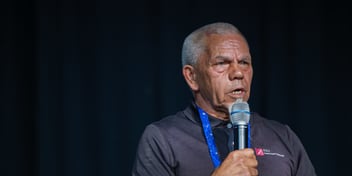
Delivering the first keynote address, National Landcare Network representative and Traditional Owner Trevor Meldrum drew on more than 30 years of land and natural resource management across Cape York to illustrate what collaboration and whole-of-system thinking look like on Country.
“There is no such thing as land, there is no such thing as sea, there is no such thing as air. Our land, sea and water are together because they are our mother and father,” he said.
“If we don’t look after them, we cannot look after ourselves.”
Meldrum discussed decades of work to control pond apple, an invasive species that had affected freshwater flows, seagrass beds, turtle nesting areas and dugong habitat along the Cape York coastline.
Years after restoration began, Meldrum saw a dugong cow and calf in an area where dugongs had previously disappeared, demonstrating the tangible results of sustained, on-Country work.
_2.jpeg?width=600&height=300&name=OeclipseAWA1F-36%20(1)_2.jpeg)
“I had a first-hand experience of what can happen when you do the work,” he said.
But achieving those outcomes required decision-makers to recognise that approaches developed for one location could not simply be imposed on another.
“One size does not fit all. We are trying to get our knowledge out, but we also want to learn from you and share our knowledge for the betterment of the whole of Australia, not just one part of it,” Meldrum said.
“None of us knows everything. I’d like to see us bring your people into our Country, take our people into your Country and work together across Australia, rather than being isolated in our little boxes.”
Meldrum said scientific and technical expertise could work alongside Traditional Knowledge when people communicated clearly, listened to Country and remained open to learning.
“The main thing is to talk plainly and talk from the heart,” he said.
Across the remainder of Day One, panel discussions and concurrent streams explored how commitments could be translated into practical change.
The program covered First Peoples-led governance, water management in homelands, drinking water quality and health, remote treatment and infrastructure, water security, workforce development and efforts to close the gap in essential water services. Presentations combined community experience with technical research and examples of capability building, monitoring and service improvement across remote Australia.
Creating change
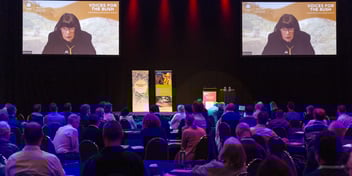
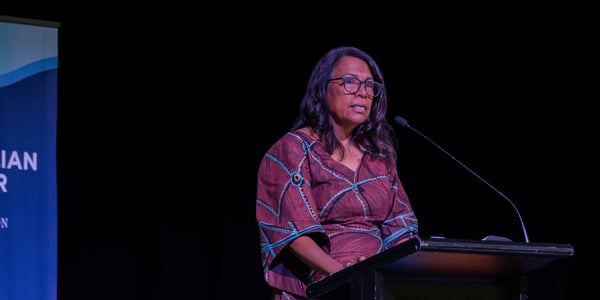
Opening Day Two, Central Land Council General Manager Professional Services Dr Josie Douglas challenged delegates to consider the structural inequalities underlying water governance and the changes required to achieve water justice.
“Water embodies, sustains and connects all life,” she said.
Drawing a parallel with the legal fiction of terra nullius, Douglas discussed aqua nullius, the idea that water belonged to no one before colonisation. She said this had denied Aboriginal systems of water law and contributed to ownership and decision-making structures that continued to exclude First Peoples.
Despite Aboriginal people reclaiming more than half of the Northern Territory’s land, Douglas said they held only a small proportion of its water licences.
“When we talk about water rights for Aboriginal people, the rights to access, use and own water is part of it,” she said.
“But the bigger picture is that the decision-making power over water remains with governments, and this power is not shared with Aboriginal people. This is why our council says water rights are the new land rights.”
Douglas also connected water justice with access to safe and reliable drinking water in remote communities, highlighting the effects of ageing infrastructure, water quality concerns and insufficient funding on housing, health and the ability of people to remain on Country.
She called for long-term investment in First Peoples water infrastructure, greater support for homelands, the reinstatement of water advisory committees and stronger protections for cultural values in Northern Territory water laws.
“Water planning starts with people,” Douglas said.
“Collectively, we can create change. Let’s turn working together into a solid reality. I ask you to walk with our members and actively try to overcome water injustice with every funding and policy decision you have the privilege and responsibility to make or to influence.”
First Peoples’ Assembly of Victoria representative Rueben Berg then shared lessons from Victoria’s treaty process, showing how sustained advocacy, clear goals and First Peoples-led structures could translate a long-held commitment into practical change.
Berg said Victoria’s first statewide treaty sought to reset the relationship between First Peoples and government, strengthen political representation and place greater decision-making authority in First Peoples’ hands.
“We were able to turn a government commitment from about 10 years ago into the first treaty, and a key part of being able to do that was small achievements along the way, making sure we had attainable goals and we set and achieved those goals,” he said.
Berg said goodwill towards self-determination had often reached its limits when governments retained final authority. Victoria’s treaty structures represented a significant shift by establishing an independent First Peoples-led body with decision-making and accountability powers.
“We don’t have to make decisions and then put it off to the minister for that final tick-off,” he said.
“We are the final decision-maker on things we have the authority to make decisions on. And that’s a really powerful shift within that Victorian landscape.”
The treaty also created opportunities to develop processes through which Traditional Owner groups could share water rights. Berg said these exchanges would not need to be confined to financial transactions and could reflect cultural practices and reciprocal relationships determined by First Peoples.
“We can design and create that system ourselves,” he said.
Berg said future Traditional Owner treaties could address water and land rights, cultural heritage management and language revival, with the priorities and processes led by Traditional Owners.
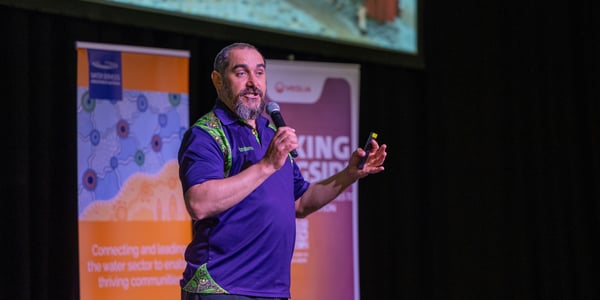
Day Two broadened the focus to the systems, relationships and capabilities needed to sustain change. Sessions examined First Peoples water governance and rights, enduring models for water ownership, cultural values in water planning and the realities of remote service delivery.
Interactive workshops and presentations also explored better coordination between housing, energy, water and waste systems, career pathways, cultural immersion, workforce planning and two-way learning grounded in Country. The program then moved into facilitated yarning circles focused on reflection, courage and action.
Day Two concluded with facilitated yarning circles, giving delegates an informal setting to reflect on the conference, share perspectives and identify actions they could take within their communities and organisations. The discussions returned delegates to the challenge set at the conference’s opening: to move beyond listening and carry what they had learned into their everyday work.
Across two days, Voices from the Bush demonstrated that stronger outcomes depend not only on better infrastructure, policy and investment, but on who sets priorities, whose knowledge informs decisions and who holds the authority to act.
The conference closed with a shared responsibility to keep building relationships, challenging entrenched systems and turning commitment into practical change for First Peoples and communities across rural, remote and very remote Australia.
Take a look at the full Voices from the Bush 2026 gallery here.
Share