



Restoring wetlands at scale through infrastructure, culture and collaboration
 by Cecilia Harris
Restoring degraded wetlands at landscape scale requires more than engineering, it depends on understanding local hydrology, protecting ecological and cultural values, and working closely with communities whose livelihoods are connected to the landscape.
The Healthy Coorong, Healthy Basin On-Ground Works Lake Hawdon North Project brought these priorities together to restore a significant wetland in South Australia’s Limestone Coast region.
Jointly funded by the South Australian government through the Department for Environment and Water and the Australian Government through the Department of Climate Change, Energy, the Environment and Water, the project received the 2026 Infrastructure Project Innovation Award (Regional), sponsored by CPB Contractors, at the Australian Water Awards.
The project was recognised for delivering wide-ranging environmental, social and economic benefits through an innovative approach to wetland rehabilitation. By combining infrastructure delivery with community, cultural and local industry engagement, the project has improved water management of Lake Hawdon North while supporting its long-term ecological health.
Department for Environment and Water’s Tom Overall said the recognition reflected the scale and significance of the work.
“It is always really nice to be recognised by your peers and to have this kind of water activity recognised as significant and important,” he said.
“Looking at the AWA award finalists, there are some incredible pieces of work being done around the country. This was one of the few undertaken primarily for ecological benefit, and to have that recognised is something we are very proud of.”
Restoring habitat at scale
The Healthy Coorong, Healthy Basin program began in 2019 in response to the declining health of the Coorong, in particular the South Lagoon, which had not recovered from the Millennium Drought to the same extent as the North Lagoon.
While longer-term management options for the South Lagoon continue to be investigated, the program identified an immediate need to provide habitat for shorebirds across the region.
Lake Hawdon North was selected as one of three restoration sites under the program’s On-Ground Works Regional Bird Refugia Project, alongside Teringie wetland complex and Tolderol Game Reserve on Lake Alexandrina.
“The aim was to provide habitat in the short to medium term for migratory waders before the implementation of any larger management strategies for the Coorong South Lagoon,” Overall said.
At approximately 2,500 ha, Lake Hawdon North presented a rare opportunity to restore this habitat at scale. The site also holds significant cultural value for First Nations of the South East, and was strongly supported through the South East Aboriginal Focus Group.
“Lake Hawdon North had been drained for decades, but has always been a significant cultural site,” Overall said.
“The South East Drainage Network offers opportunities to implement these kinds of activities to restore flows to wetlands across the region.”
The work is particularly significant in a region where only a small proportion of the wetlands present before colonisation remain, Overall said.
“For wetland restoration in the South East, this is significant. It really adds to the wetland estate within the region,” he said.
Rethinking drainage infrastructure
Understanding the site’s hydrology was fundamental to the project, Overall said. Drain L has bisected Lake Hawdon North since the early 1900’s, affecting the ability of the lake to retain water. The team needed to determine whether sufficient water remained available within the existing drain network and how water levels could be managed without adversely affecting neighbouring agricultural land.
“These drains were installed decades ago and some have seen large reductions in flow. Understanding how much water was available, how much would flow through the drain, and how we could manage that water level was critical to designing the infrastructure,” he said.
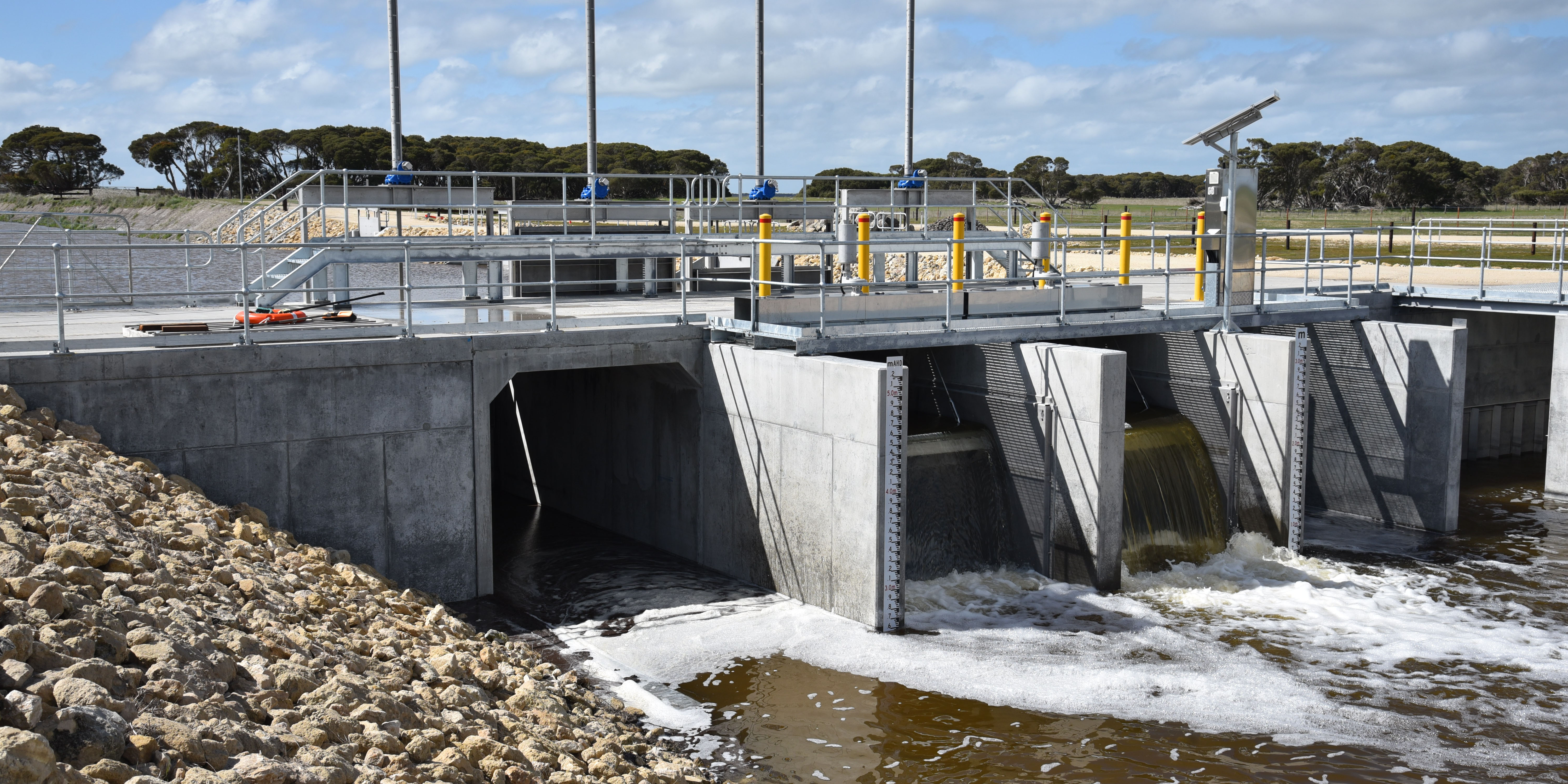
A regulating structure with lay-flat gates was installed within the Drain L, allowing the project team to raise and manage water levels across the lake. The gates are operated in consultation with neighbouring landholders to ensure agricultural activities can continue alongside the restoration work.
“The aim is to hydrate the soil and establish a bed of native aquatic vegetation so that, when the water is drawn down, there is food for bugs and microbes and eventually the birds,” Overall said.
Fishways were also incorporated, with three separate gates or bays to accommodate changing water levels, allowing fish to move between the drain and the lake under different operating conditions.
For Overall, one of the project’s most innovative elements was its reversal of the conventional purpose of drainage infrastructure.
“Drains are used for removing water from the landscape. We are now using one to ensure we can hydrate a landscape,” he said.
“Instead of draining water to the sea, we are asking how we can maintain it within the landscape. That does not just help native birds. It can also help neighbouring landholders by supporting groundwater recharge.”
Shaped through collaboration
The project was developed in partnership with the Limestone Coast Landscape Board, the South Eastern Water Conservation and Drainage Board, First Nations of the South East, local landholders, and other community representatives, with construction led by Leed Engineering and Construction.
“This was not a case of coming in with an ecological outcome and saying, ‘This is what we want’,” Overall said.
“We worked closely with all of the partners to deliver a project that benefits not just the ecology of the region, but the community more broadly.”
Engagement with First Nations of the South East took place through the South East Aboriginal Focus Group and built on an established partnership between the group and the Limestone Coast Landscape Board.
First Peoples representatives strongly supported the restoration from its early stages. Cultural heritage surveys were undertaken, monitors attended ground-disturbing works, and community members were invited to inspect the project as it progressed.
“We worked together to ensure we created as little disturbance as possible, noting that this was still a construction project,” Overall said.
“We made sure people came out and saw the work we were undertaking so they could gain a level of comfort with how the process was working.”
The project team also worked closely with landholders to address concerns about retaining water in the landscape and the potential effects upstream and downstream.
The next phase of Healthy Coorong, Healthy Basin will continue engaging First Nations of the South East, including supporting the development of a Healthy Country Plan to guide culturally appropriate management across the region.
Building resilience for the future
The restored wetland is already operating as intended, with water reaching its target level and expected bird species returning to the site, Overall said.
“It is fantastic to go back out there and see the birds we were expecting to be there, and the infrastructure operating in the way we wanted it to operate,” Overall said.
The project also demonstrates how restoring a diverse network of wetland habitats can strengthen ecological resilience amid climate extremes and emerging threats, including avian influenza.
“Resilient environments and varied habitats give birds options to move around,” Overall said.
“The more of these programs we can bring together, the more resilient we can make the environment and the better placed we will be to manage future emergencies and crises.”
Beyond the immediate outcomes at Lake Hawdon North, the team hopes the project will encourage broader thinking about how existing water infrastructure can support habitat restoration.
“These awards can lead people to think more broadly about wetland restoration,” Overall said.
“Lake Hawdon North could be a test case for future projects. We hope the partnerships built through the work remain in place for many years to come and continue to grow.”
Nominations for the 2026–27 awards season are now open. Nominate outstanding organisations, individuals, and students here.


_NL.jpeg?width=352&name=SEW%20-%20Rosedale%20Grove%20Basin%201%20(1)_NL.jpeg)
.jpeg?width=352&name=Volunteers%20and%20team%20members%20made%20it%20happen%20(1).jpeg)