 by Samantha Guy
In the rush of delivering infrastructure, managing crises, and meeting regulatory targets, the water sector rarely pauses to reflect.
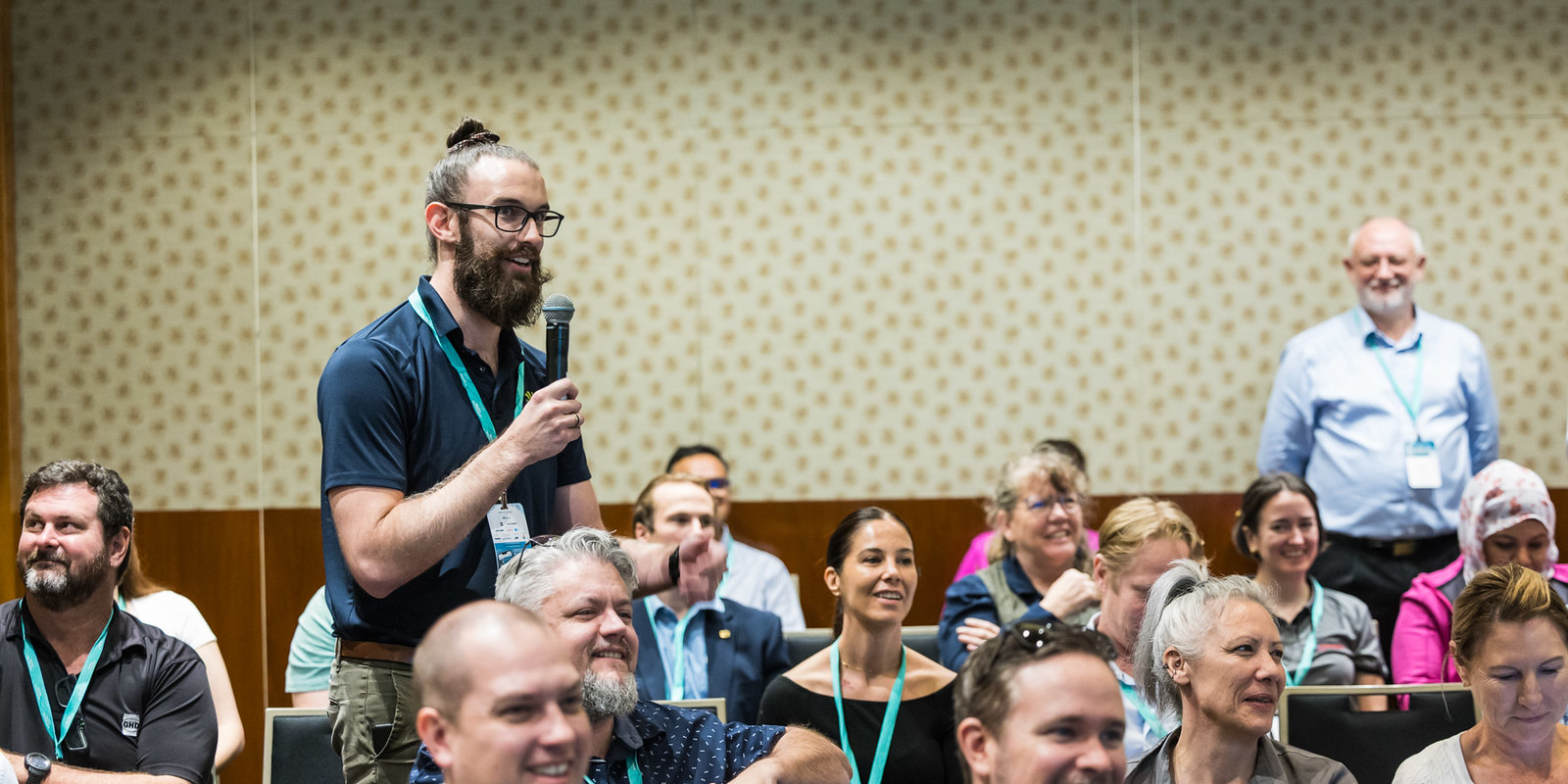
At the recent Australian Water Association’s North Queensland Conference in Cairns, a session led by Young Water Professionals invited participants to pause and reflect on the somewhat provocative question: Does our relationship with water need to change? The session kicked off Day 2 and was facilitated by Samantha Guy.
Our relationship with water
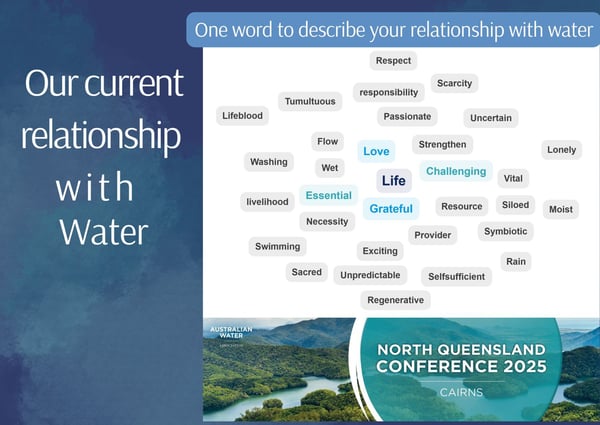
At the start, a room full of water sector professionals were asked to share one word to describe their current relationship with water. The image below captures the breadth of responses, from emotional (life, love, grateful) to challenging (scarcity, uncertain, tumultuous). These responses remind us that our work is shaped by our relationship with water in all its forms.
Why reflection matters in the water sector
Water is often described in technical terms. The language we use – an asset, a resource, a service to manage or even a challenge – reveals a lot about how we relate to water on a daily basis. This insight is important to reflect on because the way we relate to water shapes the decisions we make, the systems we build and the outcomes we seek.
The session allowed participants to explore their relationship with water through the lenses of transformation, connection, stewardship and leadership, and provided the opportunity to listen, reflect and ask how they are connected to the systems, environments and spaces that water is entwined with.
From reflection to listening
Four keynote speakers offered some powerful insights into the complexity of the sector and its relationship with water.
The conversation began with Chris Manning, National Water Sensitive City Mainstreaming Lead, who reframed urban water transformation as a “wicked problem” emphasising that it is not one big challenge, but many small, interlinked ones. He unpacked the biophysical, institutional, and social drivers that challenge us all, from siloed management, infrastructure lock-in, to ever evolving community expectations and the affordability crises. Chris emphasised that while the why and what of change are well understood, the how to make it happen remains an ongoing challenge. He suggested that our transformation journey pathway starts with reimaging new ways of working that bridge silos, integrate new disciplines and perspectives, and embeds community values and perspectives, all guided by visionary leadership and champions, a well as governance and institutional reform.
Bronwyn Opie, Director of the Cairns and Far North Environment Centre, brought the conversation home to the wet tropics. She showed the stark reality of “too much water” and “not enough water,” from fish kills in the Mulgrave River to the flooding of Cyclone Jasper. Bron argued that water literacy, the ability to truly understanding how our daily choices ripple through ecosystems, is key to building resilience. She highlighted community-led conservation as both a practical and cultural reconnection, urging us to embed ecological and cultural values in decision-making before crisis forces our hand.
From a systems perspective, Dr Sandra Hall, Chief Executive Officer of Water Stewardship Asia Pacific, explored the power of collective stewardship. She noted that sustainable water management can’t be achieved by any one group, it demands coordinated action between government, industry, communities, and Traditional Owners. Sandra outlined how water stewardship frameworks create shared responsibility, foster transparency, and build trust, shifting the conversation from compliance to care.
Closing the speaker reflections, Adam Lovell, Executive Director of the Water Services Association of Australia, spoke about leadership for systemic reform. He connected water’s role to Closing the Gap targets, from health and housing to cultural continuity, particularly in remote and Indigenous communities. Adam underscored the need for genuine engagement and community voices in shaping solutions and the courage to challenge entrenched narratives, like rebranding “toilet to tap” into something people can see, trust, and embrace. His final message: leadership is not about being a “water saviour,” but about amplifying the most powerful voice in the room, that of the community.
What we learned about change
Through the discussions and polls, several themes emerged about what it takes to change our relationship with water:
- Leadership is critical – Ranked highest as the key ingredient for transforming urban water practices was visionary and adaptive leadership, followed by institutional and governance reform.
- Connection is built through experience – When asked what helps communities connect to water, people highlighted education, lived experience, storytelling, and human connection.
- Shared responsibility matters – 82% believed all stakeholders (government, industry, community, Traditional Owners, and even nature itself) should share responsibility for water in their catchment.
But change isn’t easy. The top barriers to reform were short-term funding cycles (55%), political inertia (49%), and institutional silos (34%).
Finding hope
Despite the challenges, the word cloud for what gives you hope was dominated by people, collaboration, and passionate younger professionals. There was a clear sense that the sector’s strength lies in its human network, including those willing to care, innovate, collaborate and keep conversations alive.
In the closing poll, participants committed to action. Responses included starting conversations about water with family and colleagues, signing up for awareness campaigns, connecting with Traditional Owners, promoting water reuse, and amplifying community voices. Others ranged from practical (“turn the hot water off so my kids get out of the shower quicker”) to strategic (“challenge decision makers on their alignment with water stewardship”).
Why reflection can’t wait
In a sector dominated by urgency, pausing for reflection might feel like a luxury. But without it, we risk reinforcing the very systems and mindsets we say we want to change. Taking time to recognise our own relationship with water and listening to other perspectives plays an important role in building trust, enhancing creativity, and building our collective will for sector reform that the future demands.
The session showed that when people are given space to reflect and speak, they bring honesty, insight, and action to the table. And in that space, the seeds of a different water future can take root.
Share