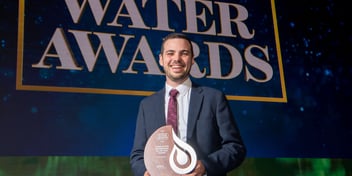
Declan Clausen on turning good ideas into lasting action
 by Cecilia Harris
Technical expertise is essential to solving the water sector’s most pressing challenges, but meaningful change also requires political judgement, community trust and the willingness to act without perfect conditions.
For Declan Clausen, Hunter Water Group Manager Strategy and External Affairs, City of Newcastle councillor and 2026 Young Water Professional of the Year, the distance between a good idea and a delivered outcome is where leadership matters most.
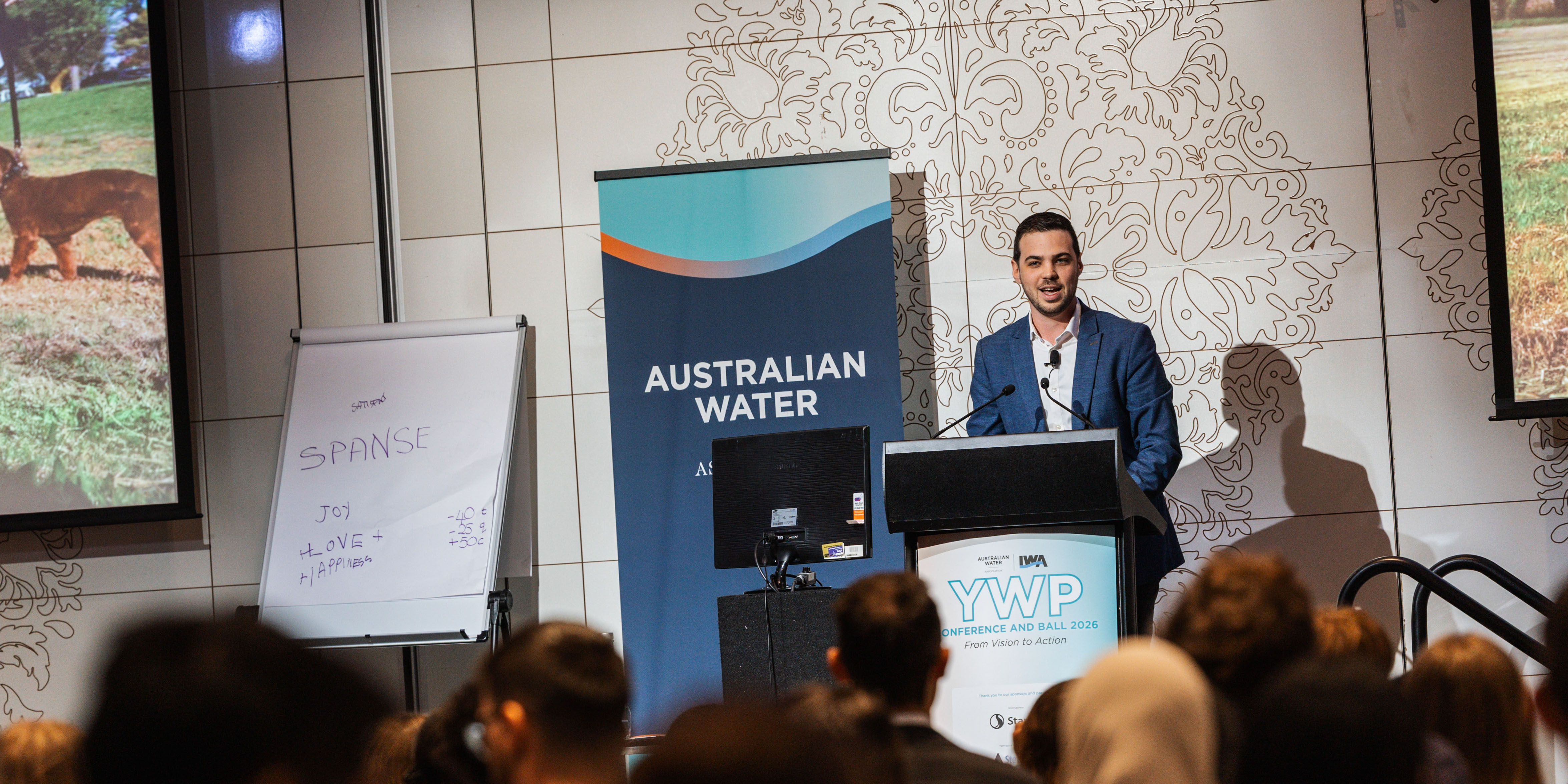
Speaking at the AWA/IWA Young Water Professionals Conference in Melbourne, Clausen drew on his experience across engineering, strategy and local government to outline five principles for turning vision into action.
“You might have the best technical answer. You might have the funding. You may even have the legal authority,” he said.
“But lasting action only happens when enough people understand the destination, trust the process and believe they have a place along the journey.”
Connect water to what people value
When the water sector performs well, the infrastructure and expertise supporting communities can be almost invisible, Clausen said.
Pipes are buried underground, dams are often far from urban centres and reliable services give customers little reason to consider what happens behind the tap or after a toilet is flushed.
“When our industry is at its best, people forget we exist. Sadly, that can include the policymakers deciding where new homes will go, what industries will grow and how our cities will adapt,” he said.
For Clausen, making water more visible does not mean asking communities to become interested in infrastructure for its own sake; it means connecting water with outcomes people already understand and care about.
“Action is so much easier on issues that people understand, feel and care about,” he said.
“It is incumbent on all of us to connect water to something that our communities already value.”
Clausen mentioned housing as one pressing example. Water and wastewater infrastructure affect the cost, location and pace of housing development, yet water professionals are not always involved early enough in planning decisions.
“Spare capacity in existing mains, pumping stations or treatment plants are public assets that our consumers have already paid for,” Clausen said.
“Water professionals therefore need to be in the room before the rezoning happens, not afterwards when someone asks whether servicing might work.”
Use the levers already available
Turning vision into action often means working within imperfect systems rather than waiting for an ideal mandate, funding model or business case.
Clausen pointed to Newcastle’s response to social and affordable housing. With more than 2,000 eligible households on the city’s social housing waiting list, the council considered what influence it could exercise despite housing being primarily a state government responsibility.
The result was a $12 million partnership with the NSW Government. The council redirects the equivalent of rates paid on public housing, while the state matches the contribution to accelerate the delivery of new homes.
“This initiative alone isn’t solving the housing crisis,” Clausen said. “It’s an imperfect intervention using the levers that are available to us. But so often, that is what leadership looks like.
“Sometimes you have to change the incentives, build a coalition and use the authority that you already have.”
For emerging water leaders, the lesson is not to confuse limited authority with an inability to act: “Use the levers that you have, not the levers that you wish you had,” he said.
Hold the vision tightly and the pathway lightly
Climate policy demonstrates why evidence and technical merit do not automatically lead to implementation, Clausen said.
Scientists have understood the warming effect of carbon dioxide for more than a century, but progress has been disrupted by changing governments, competing interests, election cycles and disagreement about cost and fairness.
“As an engineer, I come from a profession that sometimes sees this as a linear process. We want to identify the evidence, model the options and then recommend a solution. But the political process isn’t a design review,” he said.
“The perfect technical solutions that cannot survive the parliamentary process reduce exactly zero emissions.”
This does not mean abandoning the goal or accepting any compromise available. Instead, Clausen said, leaders must distinguish between the destination and the route used to reach it.
The same principle applies across the water sector. A recycled water project may be technically excellent but fail without community acceptance. A renewable hydrogen project may be sound in principle but still depend on energy, water, finance, approvals, customers and government support aligning.
“Hold the vision tightly, but the pathway lightly. Don’t compromise on where you want to go, but do not let the search for the perfect route stop you from taking good steps forward,” he said.
“The vision gives us the destination, and leadership is required to find a pathway that people can actually follow.”
Remember who receives the bill
For a sector that invests in infrastructure expected to operate for generations, leadership also means considering people who cannot yet participate in decisions.
Water businesses invest in long-lived assets today and recover those costs from customers over decades. Clausen described this arrangement as an “intergenerational contract”.
“As an industry, we already place today’s investments onto an intergenerational credit card,” he said.
Future customers will inherit the assets created today, but they will also inherit the sector’s forecasts, design choices, contingencies and mistakes.
“Intergenerational equity cannot only mean asking, ‘What more should we build now for future generations?’” Clausen said.
“It also means asking, ‘What costs and risks are we asking them to inherit?’ Those two obligations sit together.”
The sector must continue investing to address climate change, enable housing, replace ageing assets and respond to emerging contaminants. But those priorities do not remove the obligation to consider affordability and long-term risk.
“Leadership means investing for the future, but it also means taking responsibility for the bill that we send,” he said.
Leadership can begin before authority arrives
Clausen’s own water journey began at Ker-Rai Creek, a degraded urban waterway beside his high school that he monitored as captain of its Waterwatch team.
Years of advocacy and collaboration helped transform the channel into a renaturalised creek now explored by local children and cared for by a Landcare group.
“Our creek did not change because we had one perfect plan. It changed because people cared, used the levers available to them, adapted when the path became difficult and brought others with them,” he said.
For the next generation of water professionals, creating change does not have to wait for seniority, certainty or perfect circumstances.
“Twenty years ago, I looked at the creek next to my high school and thought somebody should do something about that,” Clausen said.
“What I now know is that you don’t need to wait until you’re the most senior person in the room, or until you have the perfect set of conditions. You might already be that someone.”
Interested in learning more about AWA’s YWP community? Learn more here.