
Young Australian water innovator travels to Stockholm for global water prize
 by Cecilia Harris
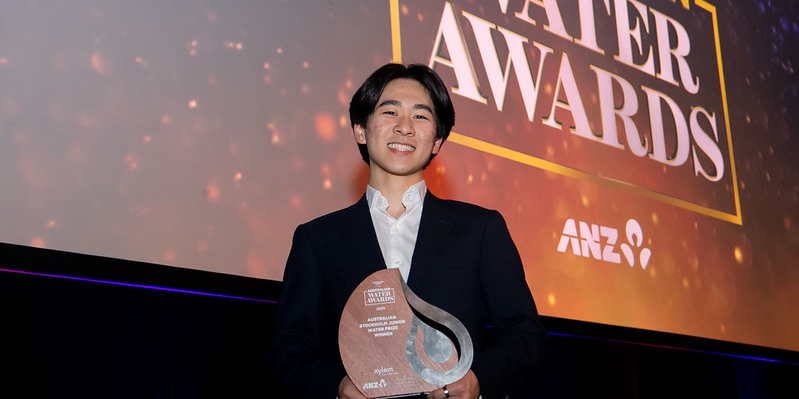
Barker College student (2024) Matthew Young was awarded the 2025 Australian Stockholm Junior Water Prize (sponsored by Xylem) earlier this year for creating a solar-powered robotic aerator that increases oxygen levels in waterways, helping to prevent algal blooms and improve water quality.
Recognised at Ozwater’25, his low-cost, scalable and autonomous design is adaptable to both urban and remote environments, offering a sustainable solution to a global challenge.
The Robotic Sub-surface Venturi Aerator is a solar-powered, robotic sub-surface aerator that uses a Venturi nozzle to boost oxygen levels in waterways, helping to prevent algal blooms and improve water quality.
“It felt incredible to win the award and have this project, that I invested over 700 hours into, be recognised and validated. It still feels surreal that I was chosen,” Young said.
The Australian Stockholm Junior Water Prize is an annual water science competition for high school students. Students are challenged to create solutions for water challenges – with the national prize awarded at Ozwater.
“This recognition as such a young innovator has inspired me to work harder and has given me the confidence to pursue more opportunities to hone my skills and abilities further,” he said.
Do you know of any bright young water scientists up for the Australian Stockholm Junior Water challenge? Find out how to get involved here.
Inspired to create change
Young was initially inspired to develop the sub-surface aerator after numerous fish kills.
“When scrolling the news in Year 11, I saw the multiple occurrences of fish kills in the Murray-Darling Basin,” he said.
“This inspired me to research into the causes of these fish kills, which led to me finding out about the harmful algal blooms that pose a major threat to water systems all around the world.
“In essence the solar-powered robot is able to move around and draw air/oxygen down into the water via a venturi aeration mechanism. This prevents eutrophication, which in turn decreases the spread of harmful algal blooms.
“Its integrated camera and computer vision also allow it to detect the presence of algal blooms, giving the opportunity to alert others if needed.”
Young said his design is well suited as an applicable solution for water needed on farms for livestock and crops.
“I see this current design as a real solution to helping farmers maintain healthy waters for livestock and see it being able to be scaled up to work more efficiently in larger waterbodies like parts of the Murray-Darling Basin,” he said.
Innovating abroad
The winner of the Australian competition is invited to participate in the Stockholm Junior Water Prize, an international competition for students aged 15-20 who develop innovative research projects addressing major water challenges.
This prestigious competition attracts tens of thousands of participants from around 40 countries worldwide, with the prestigious international accolade awarded each World Water Week in Sweden.
Young recently returned from Sweden after participating in the Stockholm Junior Water Prize ceremony and events during World Water Week.
“It’s been an incredibly unique experience,” he said.
“I’ve met so many people from various backgrounds and it’s amazing that we connect so easily even if there is a slight language barrier. Connecting with them has allowed me to see how they approach certain water issues and learn more about different issues that I didn’t cover in my project.
“This experience showed me that all over the world there are still so many critical water issues and that we still need so many innovators and innovations to help solve these problems.”
Young said one of the biggest highlights of his time spent in Sweden was connecting with likeminded students and creating a network of international peers.
“One highlight was definitely getting to know bright young people from all over the world and getting to learn about their cultures and just hanging out with them for a week,” he said.
“The second highlight was definitely the city of Sweden, which is incredibly beautiful and the tours around Stockholm were truly something.”
Working towards water
What’s next for Matthew Young? He said he sees himself working in water in future, once he has finished his university studies.
“For my project I will try to develop it further into a more solid prototype, hopefully getting funding and working with others to achieve this,” he said.
“However, even if this doesn’t work out, I definitely see myself working in the water space in the future, maybe as an internship or as a graduate, as I feel it is a very valuable endeavour.”
Do you know of any bright young water scientists up for the Australian Stockholm Junior Water challenge? Find out how to get involved here.