Meet the student turning water waste into concrete alternatives
 by Cecilia Harris
With cement responsible for roughly 10% of global CO₂ emissions, industries across the board are under growing pressure to reduce their carbon footprint. One award-winning student project is showcasing how water waste can help lead the change.
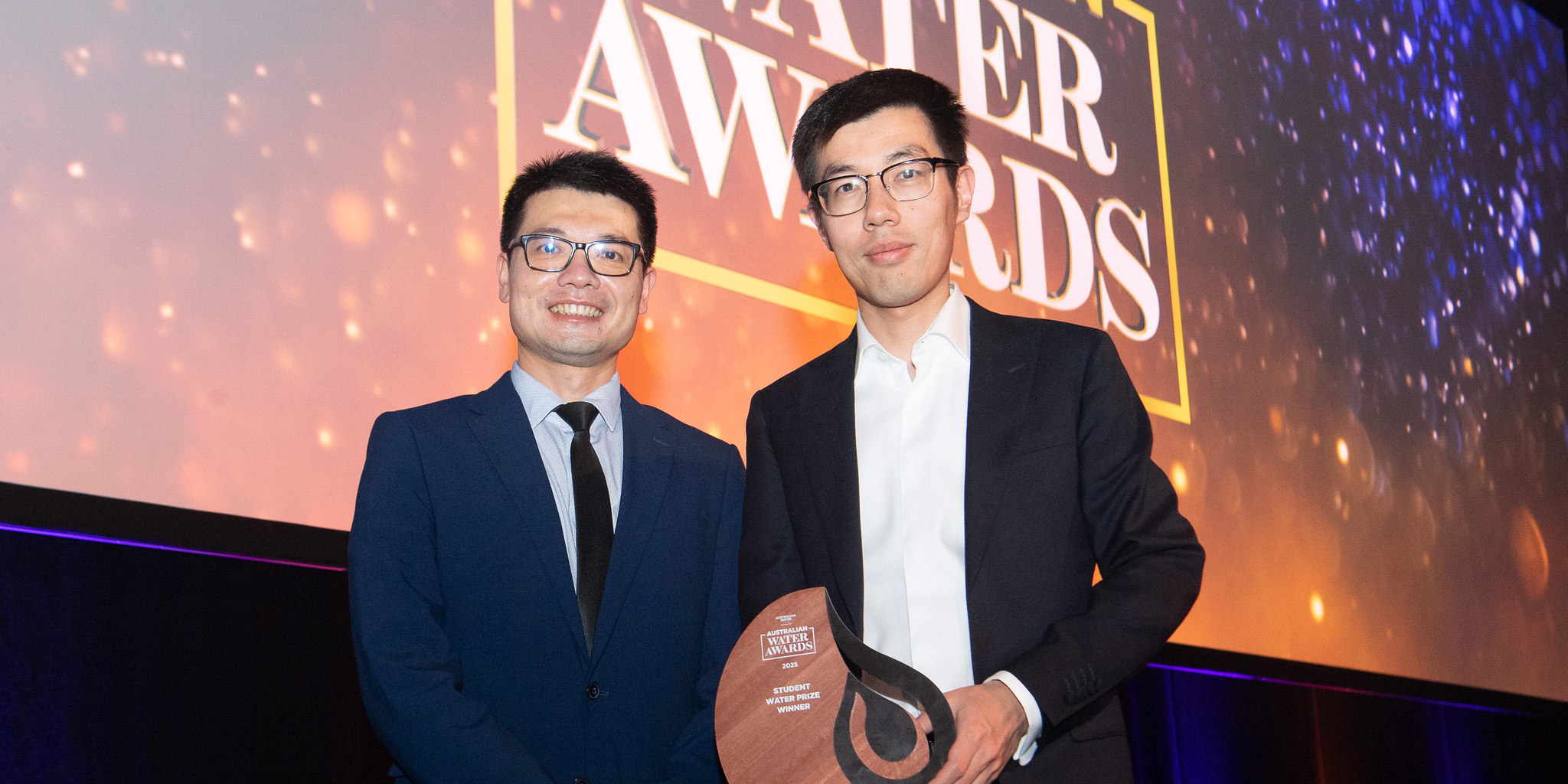
At the Australian Water Awards earlier this year, the 2025 Student Water Prize (sponsored by Guidera O’Connor) was awarded to the University of South Australia PhD candidate Weiwei Duan for his research into repurposing water treatment residue to create alkaline-activated material, a highly durable concrete alternative.
Duan said the research project was motivated by two very big challenges: resource recovery and carbon emission reduction.
"There are growing environmental issues associated with the disposal of water treatment residue (WTR), particularly aluminium-based WTR, which are typically sent to landfill. Since this type of residue is often rich in aluminium and silicon, we saw the potential to repurpose it as a valuable resource in construction materials,” he said.
"There’s also an urgent need to reduce CO₂ emissions from the construction sector, which is largely driven by cement use. Cement production accounts for about 10% of global CO₂ emissions annually. Here in Australia, we have a net-zero target for 2050, and the industry is actively seeking low-carbon alternatives to traditional cement.
“Our research group demonstrated that WTR can be used to partially replace cement, offering both environmental and economic benefits.”
Duan said his approach is unique in that its aims are to go beyond just partial material replacement: “Instead, I’m aiming to completely replace cement using WTR. Since there’s no cement involved, we call the result alkaline-activated material, or AAM”.
“In addition to eliminating cement, AAMs also exhibit superior durability properties, such as improved resistance to acid corrosion. This potentially leads to a longer service life than conventional cement-based products.”
Nominations for state and territory awards are now open. Nominate standout projects and individuals here.
Innovating through challenge
One of the biggest challenges Duan faced during the project was figuring out how to pretreat the WTR to ensure the end product was fit for purpose.
"Collecting WTR is easy because it’s already stockpiled, but we had to pretreat the material to activate it for our application. The real challenge for me was achieving sufficient early strength for the material under normal curing conditions,” he said.
“For construction materials like concrete, it’s crucial that the fresh mix has sufficient flowability so it can be shaped in moulds as designed. Once shaped, the material must then cure - it must harden and gain strength under controlled temperature and humidity.
“However, AAM typically requires elevated curing temperatures above 40°C, which limits its practical use, especially on-site where we can’t control the environment."
To overcome it, Duan studied the underlying reaction mechanisms, did a lot of literature review and research, and identified calcium as a key component for improving performance.
“While WTR is rich in aluminium and silicon, it lacks calcium so we had to add it. I developed a hybrid-phase AAM by incorporating another industrial by-product, ground granulated blast furnace slag (GGBFS), which is rich in calcium,” he said.
“Through this, we were able to significantly enhance early strength development at room temperature, making the material much closer to being suitable for real-world use.”
What’s next?
Duan recently took on a position at a local cement company in South Australia, but said he sees strong potential to take the research further.
“I still have connections with UniSA and am supporting our research group in collaboration with industry partners to pilot this material in real infrastructure applications," he said.
“We’re particularly looking at applications in sewage and stormwater systems, where durability is essential. We’re also investigating how characteristics of WTR from different water treatment plants affect the final product’s performance. That’s key to scaling up and commercialising the material.”
In Duan's current position, he is also exploring ways to incorporate other industrial waste streams into similar cementitious or activated systems in an effort to expand the possibilities for circular construction.
“There’s a great need for circular economy approaches to achieve sustainability - especially here in South Australia. To reduce CO₂ emissions, we need materials to replace cement. We call them supplementary cementitious materials, or SCMs,” he said.
“But in South Australia, we don’t have local sources of these materials. We have to import them. So from that perspective, I really want to find materials we can use locally. That gives me the drive to pursue circular economy solutions and sustainability in my work.”
Award winning work
And in terms of winning the 2025 Student Water Prize? Duan said it was a memorable experience, and one that showcases just how important circular economy work truly is.
“Winning the award was unbelievable. I couldn’t believe I’d won," he said.
“Personally, it’s a proud milestone that reflects the years of study - not just mine, but also the support and collaboration from my supervisors, colleagues, and family.
“Professionally, I see it as a huge validation of the relevance of this research to real-world challenges in the water sector. It gives me great confidence to keep pursuing applied, sustainability-driven solutions in my future career.”
Do you know about an amazing student water project that deserves the spotlight? Nominations for the state and territory awards are now open.