Gold Coast trials low-energy biosolids drying technology
 by Water Source
The City of Gold Coast is trialling a novel biosolids drying technology that could dramatically cut costs, energy use and truck movements, marking one of the sector’s fastest shifts from research to real-world application.
At a time when wastewater operations are under growing pressure to rein in operating costs and reduce emissions, biosolids management remains a stubborn challenge. For the City of Gold Coast, it is one of the largest and most complex components of wastewater operations, and one that is increasingly hard to manage using traditional methods.
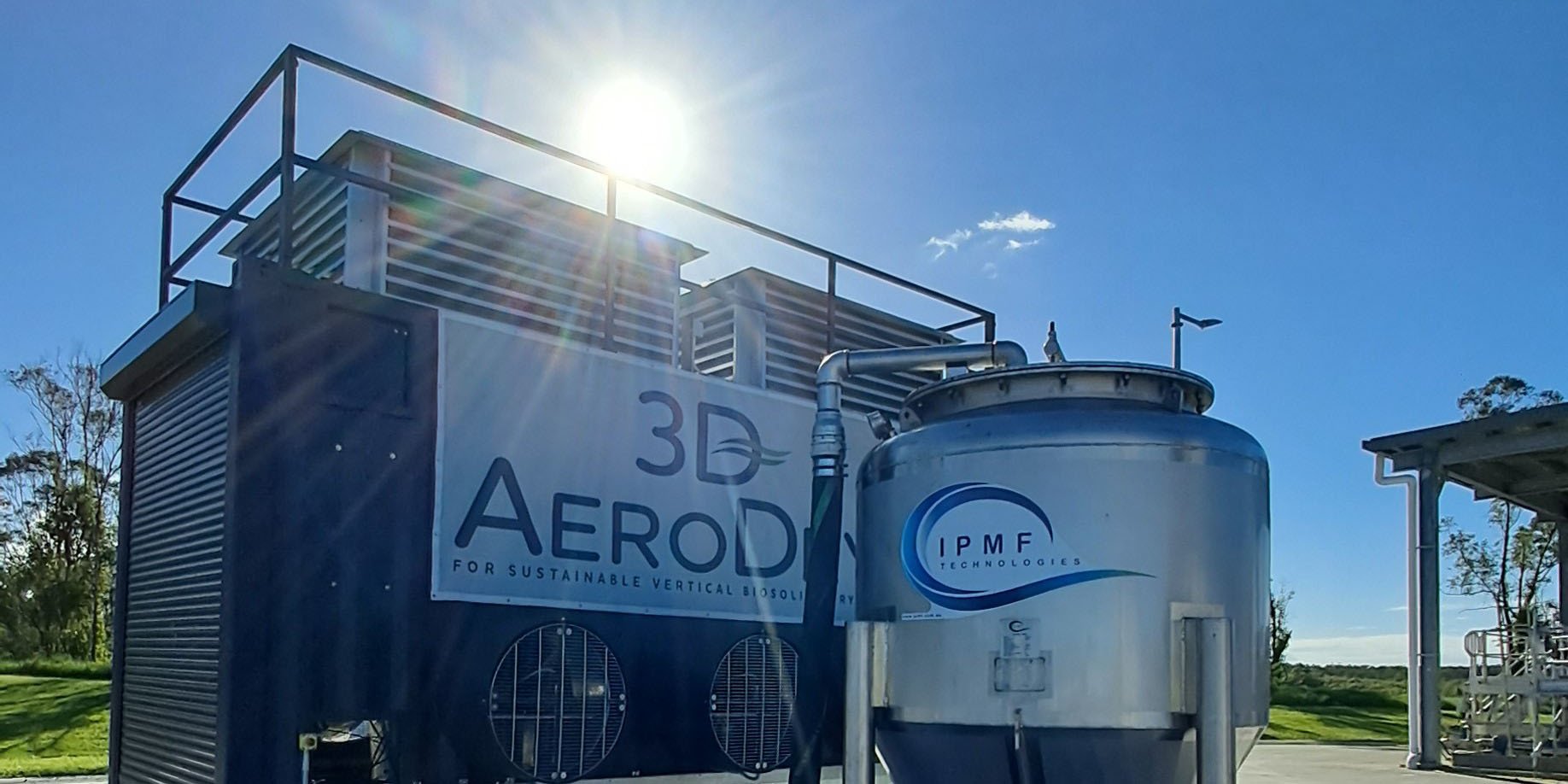
That challenge has prompted the City of Gold Coast to trial a new approach with start-up IPMF Technologies, deploying its 3D-AeroDry® system at the Coombabah Sewage Treatment Plant (STP).
The year-long demonstration trial, now under way, is testing whether biosolids volumes can be reduced by up to 85% at ambient temperatures, without external heat.
“If successful, this technology could reduce operating costs by millions while improving wastewater logistics and our carbon footprint,” said Mayor Tom Tate.
Why traditional drying is no longer enough
Biosolids management costs are driven largely by moisture. High water content means more volume, more handling, and more transport – all costs that add up quickly.
According to Project Manager Shao Yap, the City’s existing drying approach has become increasingly difficult to rely on. “Biosolids management is one of the City’s largest operational costs. Current drying methods are energy-intensive and expensive, largely due to the high moisture content,” he said.
At Coombabah STP – the City’s largest treatment plant – biosolids are currently dried using uncovered drying beds. While the approach is simple and low-energy, it comes with significant limitations.
“This method is highly weather-dependent, resulting in inconsistent drying performance, especially during wet, cool, or humid conditions,” Yap said. “Additionally, drying beds require a large footprint, limiting land availability for future plant expansions and upgrades.”
There is also growing uncertainty around how to manage emerging contaminants such as PFAS and microplastics, adding another layer of complexity to biosolids handling and reuse.
Together, these pressures led the City to look beyond incremental improvements and consider a fundamentally different drying process.
How the technology works
Unlike conventional drying systems that rely on large open areas or energy-intensive thermal processes, 3D-AeroDry® takes a vertical approach.
The system suspends dewatered biosolids in thin vertical layers within specially designed structures, maximising the surface area exposed to ambient air. This accelerates evaporation without the need for external heat.
“3D-AeroDry works by suspending dewatered biosolids in thin vertical layers within specially designed vertical structures,” Yap said. “This helps to maximise the surface area of biosolids exposed to surrounding air for efficient water evaporation and drying at ambient temperatures.”
The modular design means the system can be scaled up or down as needed, while its compact footprint significantly reduces land requirements compared to traditional drying beds.
The project moved quickly from concept to deployment. After securing $400,000 through the Federal Government’s Entrepreneurs' Programme – Accelerating Commercialisation Grant, the demonstration plant was completed in April 2025 and installed at Coombabah STP soon after. The speed of delivery makes it one of the fastest transitions from research and development to commercialisation seen in the utilities sector in recent years.
Early results from the Coombabah trial
Since operations began, the demonstration plant has delivered strong early performance.
“During the trial, we observed rapid and efficient drying, consistently achieving up to 90% solids within two to three days and reducing volume by approximately 85%,” Yap said.
The implications are significant. An 85% reduction in biosolids volume could eliminate around 1600 truck movements each year, easing pressure on local roads and cutting associated emissions.
“This reduction would significantly cut biosolid transport requirements,” Yap said. “It would ease pressure on logistics and local roads while lowering carbon emissions, supporting the City’s sustainability and climate targets.”
Energy use has also been closely monitored. To date, the system has required less than 100 kilowatt-hours per tonne of water evaporated, making it three to seven times less energy intensive than conventional thermal drying technologies.
The vertical design reduces the footprint by a factor of five, with potential reductions of 10 to 15 times compared to Coombabah’s existing drying beds. Operationally, the system also produces dried biosolids pellets that are odourless, stable and easy to handle.
“Furthermore, no hazardous gases – such as methane or hydrogen sulphide – have been detected during operation, indicating a safe and controlled process environment,” Yap said.
Coombabah STP Supervisor Todd Champman said the results to date point to a step change in performance. “3D-AeroDry® can achieve 80% biosolids volume reduction with minimal energy input and zero heat – a breakthrough that could save the City millions in operating costs,” he said.
What it could mean for the sector
While the immediate focus is on the City’s own operations, the broader implications are hard to ignore.
Globally, more than 100 million tonnes of biosolids are produced each year, with management costs often accounting for around half of sewage treatment operational expenses.
“Successful implementation of this technology can help achieve significant savings on the biosolids management cost and drive a more sustainable future for wastewater treatment worldwide,” Yap said.
For IPMF Technologies, the project highlights the importance of collaboration between utilities and innovators. “At IPMF Technologies, we turn ideas into real-world solutions – made possible by partners like the City of Gold Coast who are willing to take the first step,” said co-founder Ilje Pikaar.
Yap described the partnership as a model for applied innovation. “This project brings the right people together to deliver real innovation for practice with outcomes that are both transformative and genuinely sustainable,” he said.
As the trial continues, the City will be watching performance, reliability and scalability closely. If results continue to stack up, the technology could offer a practical pathway to lower costs, smaller footprints and lower emissions – not just on the Gold Coast, but across the wastewater sector.
This project received grant funding from the Australian Government.
Interested in learning more about circular approaches to waste management? Check out the Water Nexus: Achieving a Circular Economy sub-theme at Ozwater'26.